Summer Vehicle Maintenance in Avenel, NJ
Most buyers think about their trade-in as a secondary detail, something to sort out after they've found the car they want. In practice, how you handle your trade-in can affect the total cost of your purchase by thousands of dollars in either direction. At a multi-brand dealership like Sansone Auto Group, with over 2,000 new and pre-owned vehicles across 10 brands, the trade-in conversation has more flexibility than it does at a single-brand store, and understanding why helps you use it. How Dealers Actually Value Your Trade-In Before you can negotiate effectively, it helps to understand what's happening behind the appraiser's offer. Every trade-in offer starts from a figure called Actual Cash Value, or ACV, the dealer's estimate of what your vehicle is worth at wholesale right now. From there, the dealer subtracts expected reconditioning costs and a margin before arriving at the figure they present. The core inputs that drive your ACV: Year, make, and model - some vehicles hold value significantly better than others Mileage - higher miles compress the offer, particularly past 100,000 miles Condition - exterior, interior, and mechanical state, each assessed separately Accident history - pulled via VIN report; prior accidents reduce value, even repaired ones Local demand - a high-demand used vehicle on a lot that needs it gets a stronger offer than the same car in a market with oversupply The reason trade-in value is lower than private-party or retail value is structural: the dealer covers reconditioning, auction costs if the vehicle is wholesaled, and their margin to resell. Understanding this prevents you from anchoring to the retail price of a similar vehicle and feeling shortchanged, the figures represent different stages of the same transaction. What You Can Do Before the Appraisal Get at least two independent valuations first. Enter your VIN or license plate (more accurate than make/model/year alone), mileage, and honest condition assessment. The trade-in value range from both tools gives you a realistic floor for the conversation. You can also get a trade-in appraisal from Sansone Auto online before your visit, the tool gives you a real starting estimate based on your vehicle's details before you set foot on the lot. Clean the car, fix the simple things, skip the expensive ones. A detailed interior and a clean exterior signal to an appraiser that the vehicle was cared for. However, skip major mechanical repairs. Dealers recondition vehicles at internal wholesale rates, you are unlikely to recover a $1,500 repair in a higher offer. Gather your maintenance records. A documented service history gives the appraiser confidence in the vehicle's condition and can support a higher condition tier assessment. Bring whatever records you have, dealer service receipts, oil change records, any warranty documentation still in effect. Why Multi-Brand Inventory Changes the Trade-In Equation Here is the specific advantage of trading at a multi-brand group that most buyers don't think about. At a single-brand dealership, your trade-in is either useful to their used inventory or it isn't. If your vehicle doesn't fit their typical customer profile, it's likely to be wholesaled, meaning the dealer's offer reflects auction value, not retail potential. At a dealership group with 10 brands and over 2,000 vehicles in inventory, there is a significantly wider range of buyers cycling through. A trade-in that isn't an obvious fit for one brand's customer profile may be exactly what another brand's buyer is looking for. That broader retail potential means the dealer has more reason to offer retail-adjacent value rather than defaulting to wholesale pricing on vehicles outside a narrow profile. In practical terms: if you're trading in a Honda, a Jeep, or a Toyota at Sansone, the pre-owned inventory spans enough of the market that your vehicle has a realistic path to retail resale, which is reflected in the offer. The One Rule That Matters Most: Keep Negotiations Separate This is the most consistently cited advice from automotive industry analysts and consumer advocates, and it matters regardless of where you buy. Negotiate the price of the vehicle you're buying first, independent of your trade-in. Only after you have an agreed out-the-door price on the new vehicle should you bring your trade-in into the conversation. When both figures are negotiated together, a dealer can shift profit between them, offering more on the trade while adjusting the new vehicle price, or the reverse. Keeping them separate means you know the real value of each. The same logic applies to monthly payments. A dealer can make any number look more favorable by stretching the loan term. Always anchor your negotiation to the out-the-door total price, the full amount you will pay, including all fees, before financing. A Note on Negative Equity If you currently have a loan on your trade-in, the process has one additional step. Sansone's team can contact your lender directly to get a payoff amount. If your car is worth more than you owe, the positive equity rolls into your new purchase. If you owe more than the vehicle is worth, the gap needs to be closed with cash or rolled into your new financing. Knowing your payoff amount before you arrive gives you a clearer picture of your starting position. Start Your Trade-In Appraisal at Sansone Auto Sansone Auto Group is located at 90-100 Route 1 North, Woodbridge, NJ 07001. You can start your trade-in appraisal online before your visit to get a real estimate on your current vehicle. The team can walk through the valuation, apply it toward any vehicle across all 10 brands in inventory, and handle the lender payoff directly if your vehicle has an existing loan. FAQs How does a dealership determine my trade-in value? Dealers start from your vehicle's Actual Cash Value, a wholesale estimate based on year, make, model, mileage, condition, accident history, and current local demand. They then subtract expected reconditioning costs and a margin before presenting an offer. Should I negotiate my trade-in and new vehicle purchase at the same time? No. Industry analysts consistently recommend negotiating the out-the-door price on your new vehicle first, before introducing the trade-in. When negotiated together, profit can shift between the two figures in ways that are difficult to track. Keeping them separate gives you a clear picture of what each is actually worth. What should I do before bringing my car in for a trade-in appraisal? Clean the car thoroughly, fix inexpensive issues like burned-out lights or a cracked windshield, and gather your maintenance records. You can also get a preliminary estimate at sansoneauto.com/trade.aspx before your visit. Can I trade in a car that still has a loan on it? Yes. If the car is worth more than what you owe on it, the positive equity can be used toward your new purchase. If you owe more than the car is worth, you can either make up the difference in cash or roll it into the new loan. Sansone’s team handles the lender payoff directly. Why might I get a better trade-in offer at a multi-brand dealership? A dealership with a wide multi-brand inventory has a broader range of buyers and a higher likelihood of retailing your trade-in rather than wholesaling it. Vehicles that don't fit a single-brand profile often get lower offers because the dealer expects to send them to auction. A multi-brand group has more retail pathways for more vehicle types.
If you've been shopping for a pre-owned vehicle at Sansone Auto Group, you've likely seen both "used" and "certified pre-owned" listings sitting side by side, sometimes for the same make and model, at noticeably different prices. The difference isn't just marketing. It's a meaningful distinction that affects your warranty coverage, the condition of the vehicle, and your total risk as a buyer. Here's what each actually means. What Is a Regular Used Car? A used car is any vehicle that has previously been owned by someone else. That's the full definition. It could be a one-owner lease return with 18,000 miles, or a five-owner vehicle with a patchy service history. The condition, mileage, and maintenance record can vary dramatically from one used car to the next. Warranty coverage on a regular used vehicle varies. Some may be sold without additional dealer warranty coverage, while others may retain factory coverage or qualify for protections required by applicable law. Comparable non-certified used vehicles may have a lower asking price than CPO vehicles because they do not include the same manufacturer certification requirements and benefits. For buyers who are budget-conscious, comfortable doing their own research, or willing to have an independent mechanic inspect the vehicle before purchase, a regular used car can be excellent value. What Is a Certified Pre-Owned Vehicle? A certified pre-owned vehicle is a used car that has passed a multi-point inspection before it is placed for sale to the public. Each manufacturer sets its own CPO requirements, including inspection criteria, age limits, mileage thresholds, and warranty terms, so specifics vary by brand. If repairs are needed to meet the manufacturer's standards, they're completed before the vehicle enters the CPO inventory. At Sansone Auto Group, CPO vehicles are manufacturer-certified, meaning they meet that brand's own program standards rather than a dealer-defined certification. CPO programs vary by manufacturer. The eligibility varies significantly by manufacturer and certification tier. Some mainstream CPO programs limit vehicles to about six model years and roughly 80,000 miles, while other certified tiers allow older or higher-mileage vehicles. To qualify for CPO status, a vehicle typically must: Meet the manufacturer’s specific age requirement. Meet certain mile requirements on the odometer (differs as per brands) Carry a clean, non-branded title Pass a manufacturer-specific multi-point inspection, often 100 to 200 inspection points depending on the brand Be reconditioned using OEM parts where needed The CPO warranty is the critical piece. Unlike a dealer-only warranty, a manufacturer-backed CPO warranty is honored at any authorized dealership of that brand nationwide, not just where you bought the car. Many manufacturer CPO programs include roadside assistance, but duration and coverage vary by brand and certification tier. What's the Actual Difference? A Direct Comparison Regular Used Car Certified Pre-Owned Inspection Basic multi-point inspection Manufacturer multi-point (100–200 points) Warranty As-is or remaining factory Manufacturer-backed CPO warranty Age / Mileage Requirements No limits Limits vary as per brands Title Requirement None Clean, non-branded title required Reconditioning Not required Required before certification Financing Standard used rates Often lower CPO-specific rates Price Lower Higher than used, lower than new Roadside Assistance Typically not included Often included Is a Certified Pre-Owned Vehicle Worth the Extra Cost? The honest answer depends on how you weigh certainty against savings. Certified pre-owned cars have strict age and mileage limits, pass inspections, and often come with manufacturer-backed warranties. These benefits are expensive but provide further peace of mind and security. Standard used cars typically cost less, offer greater variety, and may lack warranties or complete service records, placing more responsibility on buyers to assess condition and value. For buyers who want to minimize risk, who don't want to worry about an unexpected repair bill six months after purchase, the CPO premium buys real peace of mind. The manufacturer has already inspected the vehicle, addressed any issues, and staked its warranty program on the result. For buyers who are comfortable doing due diligence, getting a vehicle history report, having an independent mechanic inspect the car, and accepting a degree of uncertainty in exchange for a lower price, a standard used vehicle can be excellent value. One important distinction worth knowing: always choose a manufacturer-backed CPO program over a dealer-specific certification to ensure your warranty is valid nationwide. A dealer-only certification does not carry the same protections, it's the manufacturer's name on the warranty that matters. CPO Options at Sansone Auto Group Sansone Auto Group carries pre-owned and certified pre-owned inventory across brands, from one location on Route 1 in Woodbridge, NJ. Whether you're looking for a CPO vehicle with full manufacturer backing or a competitively priced used option, the team can walk through what's available within your budget and help you understand exactly what coverage comes with each vehicle. Browse Pre-Owned Inventory to see current CPO and used listings across all brands, or contact the sales team directly to ask about certification status on a specific vehicle before your visit. FAQs What does certified pre-owned mean? A certified pre-owned car is a used car that has been inspected and reconditioned to certain standards and comes with a manufacturer warranty. It has passed a multi-point inspection required by the manufacturer. It usually also has to be 5 to 6 model years old with less than 75,000 to 80,000 miles. Is a certified pre-owned car better than a used car? It depends on your priorities. A CPO vehicle gives you more peace of mind, a checked condition, manufacturer warranty, and sometimes lower rates of financing. A used car that is not a standard will generally be cheaper, but with less certainty. Neither is universally better; the right choice depends on your budget and risk tolerance. Is a dealer-certified car the same as a manufacturer CPO? No. A dealer certification is not the same as a manufacturer-backed CPO program. Only manufacturer CPO warranties are valid at any authorized dealership of that brand nationwide. Dealer-only certifications vary widely and do not carry the same standardized protections. How many miles can a certified pre-owned car have? Mileage limits vary widely by brand and certification level. Hyundai Certified allows up to 80,000 miles; Toyota Silver can allow up to 125,000 miles; Nissan Certified Select can allow up to 100,000 miles. Where can I find certified pre-owned vehicles near Woodbridge, NJ? Sansone Auto Group at 90-100 Route 1 North, Woodbridge, NJ 07001 carries CPO and pre-owned inventory across 10 brands. Browse current listings online or come see the showroom to compare options in person.
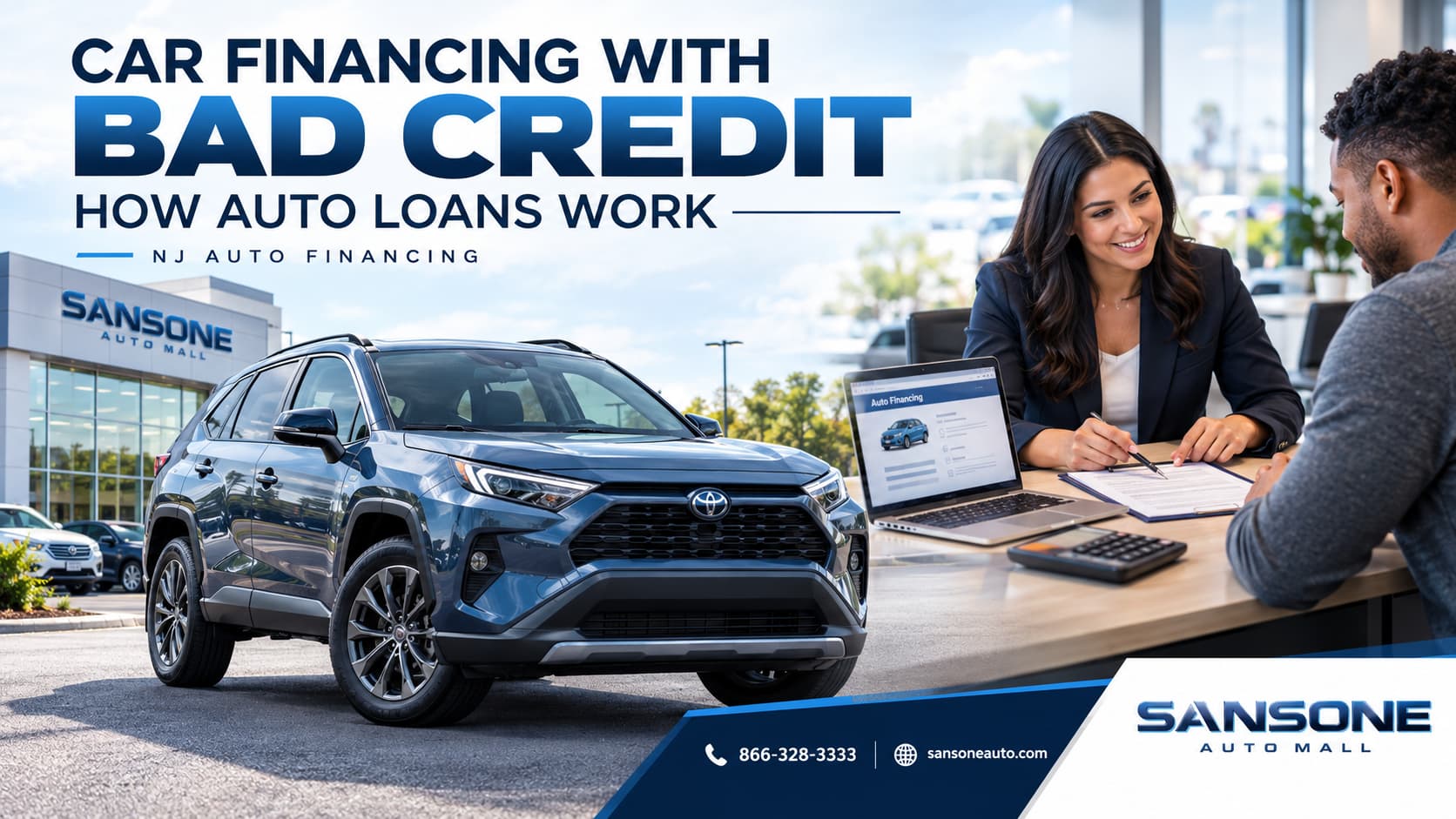
If you're searching for car financing with bad credit in NJ, "100% Approvals Is Our Goal" is the first thing you see on Sansone Auto's homepage. It's a bold statement, and it raises a reasonable question. Does it mean everyone who walks in gets approved? And if your credit score has taken hits from missed payments, medical bills, or a past repossession, does it actually apply to you? The answer requires understanding how car financing works when your credit is poor. The basic auto-loan process is similar, but borrowers with weaker credit may face different lender requirements, higher APRs, larger down payments, or fewer financing options. How Do Lenders Actually Look at Bad Credit? Lenders will look at more than your credit score when you apply for a car loan with bad credit. The score is a good starting point, but lenders and dealers also look to: Income and employment stability. Most buyers underestimate the value of a stable, verifiable income. Lenders want proof you can pay monthly, not that you want to pay. Usually you have to prove this with pay stubs, bank statements, or tax returns. Down payment A larger down payment can reduce the amount financed and may improve approval chances or loan terms. Some lenders may require around 10% or more for borrowers with poor credit, but requirements vary. Debt-to-income ratio DTI compares your monthly debt obligations with your gross monthly income. If that ratio is already high, adding a car payment creates more risk in the lender's eyes. Reducing existing balances before applying, where possible, can help. Vehicle choice The loan amount relative to the vehicle's value matters. Financing a $12,000 used vehicle is less risky for a lender than financing a $45,000 new one when your credit is poor. For buyers with damaged credit, a pre-owned vehicle in a realistic price range often opens more lending options than a brand-new model. What Does "100% Approvals Is Our Goal" Actually Mean? This is a goal statement, not a guarantee. The message is that the finance department at Sansone Auto works with multiple lenders, not just one bank, and the team is trying to find a way to get each buyer that walks in the door financed, no matter what their credit history may be. In practical terms, this means: Access to multiple lending sources A dealer who has a network of lenders, including subprime and non-prime auto lenders, has more tools at his disposal than a consumer walking into one bank branch. One lender may decline you but another with a different credit scoring system may approve. Subprime auto loan programs Bad credit car loans in NJ, often called subprime auto loans, are specifically designed for buyers with credit scores below 620. They carry higher interest rates than prime loans, that's the trade-off for access, but they exist precisely because lenders have built risk-adjusted products for this buyer segment. A dealer with subprime lending relationships can connect buyers to these programs. In-house flexibility on vehicle selection At a multi-brand group like Sansone, with thousands of new and pre-owned vehicles across multiple brands, there's significantly more room to match a buyer's approval amount to a vehicle in inventory. If a lender approves $15,000 rather than $25,000, the team can work within that range across the full inventory rather than being limited to one brand's lineup. What Should You Know Before You Apply? Get a car loan pre-approval in NJ before you shop Sansone Auto's online car loan pre-approval in NJ takes a few minutes and gives you a realistic picture of what you qualify for before you're in the dealership. Knowing your approval amount in advance means you shop within your range rather than falling in love with a vehicle outside it. Understand the total cost, not just the monthly payment A bad credit auto loan typically carries a higher interest rate, and on a 60 or 72-month loan, that rate compounds meaningfully over time. A lower monthly payment that stretches over a longer term can mean paying significantly more in total than a higher monthly payment on a shorter term. Ask for the total interest paid over the life of the loan, not just the monthly figure. A cosigner can change the equation If you have a family member or partner with stronger credit who is willing to cosign, lenders treat the loan as their risk as much as yours. This can unlock better interest rates and a wider range of vehicle options. The cosigner takes on real financial responsibility if you miss payments, both parties need to understand this clearly before proceeding. On-time payments rebuild credit If the lender reports the account to the credit bureaus, consistent on-time payments can contribute positively to your credit history, although the exact effect on your credit score varies. Visit Sansone Auto in Woodbridge, NJ Sansone Auto is located at 90-100 Route 1 North, Woodbridge, NJ 07001, one location, with thousands of new and pre-owned vehicles across multiple brands. You can start your pre-approval application online before visiting, or contact the finance team directly to understand your options before committing to anything. The goal is to find a path forward for auto financing with bad credit, and with multiple lenders and a large multi-brand inventory, there's more flexibility here than at most single-brand dealerships. FAQs Can I get a car loan with bad credit at Sansone Auto? Yes. Sansone Auto's finance department works with several lenders who specialize in auto financing with bad credit, including subprime programs for buyers with damaged or limited credit history. What does "100% Approvals Is Our Goal" mean? It means Sansone Auto's finance team works with a network of lenders, not just one bank, and actively works to find an approval path for every buyer, regardless of credit history. Will a car loan help rebuild my credit? Yes. If you make all your payments on time on a subprime auto loan, that will be reported to the credit bureaus and help your credit profile while the loan is active. One of the best ways to rebuild credit after financial hardship is by making on-time payments consistently. Do I need a down payment if I have bad credit? A larger down payment reduces the lender’s risk and greatly improves both approval odds and loan terms on a bad credit auto loan. While there is no fixed minimum, buyers with damaged credit who can put down 10–20% of the vehicle's value typically see better results. How do I start the process at Sansone Auto? Complete the online pre-approval application at sansoneauto.com/preapproved.aspx. The process takes a few minutes and gives the finance team what they need to match you with the right lender and vehicle range before your visit.
DISCLAIMER: Dealer shall in no way be held liable for any errors or omissions to be found on this website. Price(s) include(s) all costs to be paid by a consumer, except for licensing costs, registration fees, and taxes. Prices are subject to change without notice. Any purchaser or prospective purchaser should independently verify with a salesperson the accuracy of all information listed on this website. Actual equipment of this vehicle may differ. Contact store for more details.