Blog / Sansone Auto

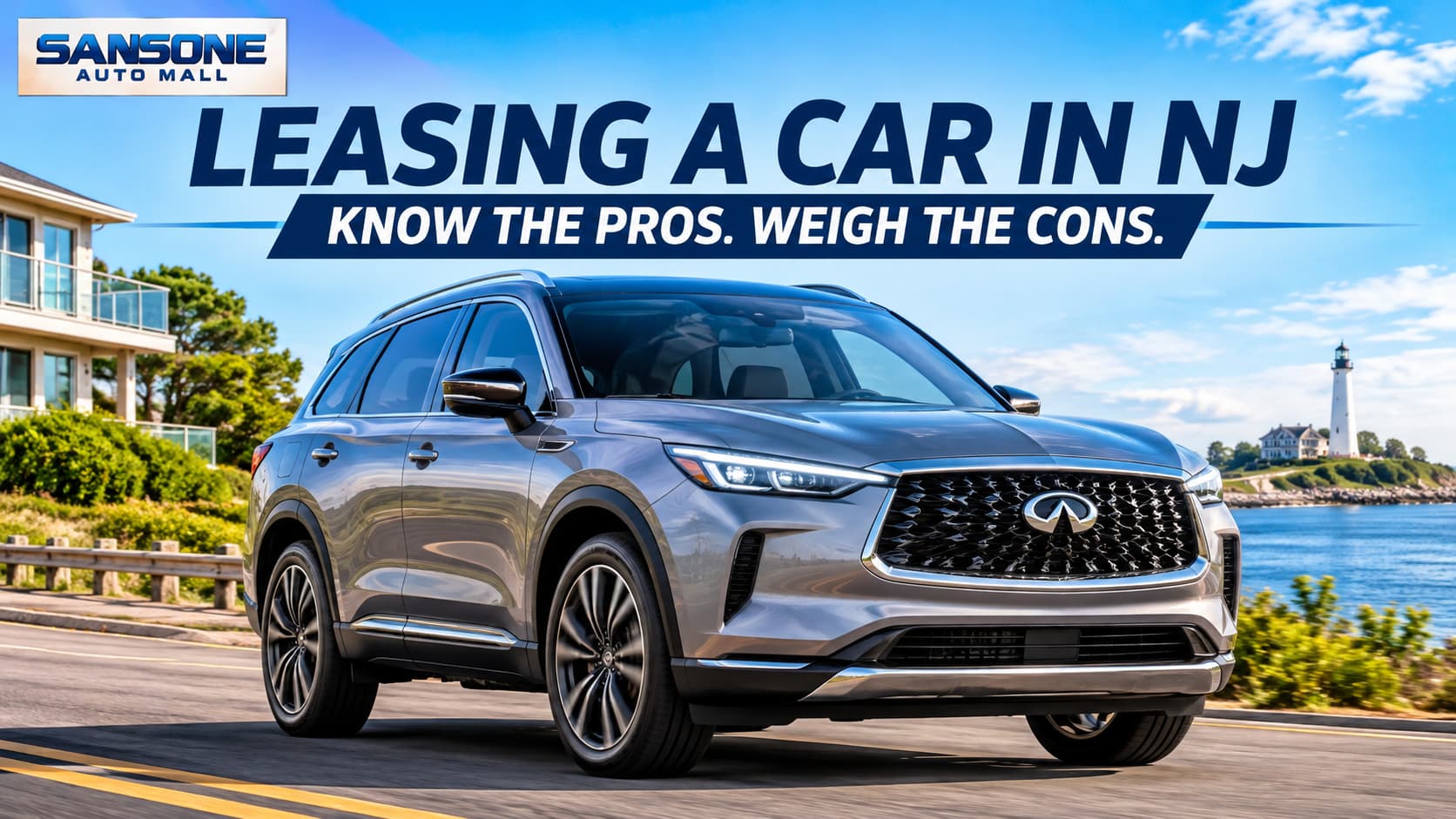
Pros and Cons of Leasing a Car in NJ: What Buyers Need to Know in 2027

A car for lease

Leasing gets brought up a lot when monthly payment is the main concern. The numbers look better on paper than a purchase loan for the same vehicle, and that is what pulls most people toward it. What the payment does not show is the full picture of what you are agreeing to, what it will cost at the end of the term, and whether the structure actually fits how you use a vehicle day to day.

This guide covers how leasing works, where the real costs show up, and how to figure out whether a lease or a purchase makes more sense for your situation in 2027.

How Leasing Works?

When you lease a car, you pay for its expected depreciation during the lease term, plus a rent charge (financing cost), applicable taxes, and fees. The leasing company establishes the vehicle's residual value, which is its projected value at the end of the lease. The monthly payment is generally calculated using the vehicle's adjusted capitalized cost, residual value, rent charge, and applicable taxes and fees. 

At the end of the lease, you can typically return the vehicle, purchase it if your agreement includes a purchase option, or enter a new lease. Additional charges may apply for excess mileage, excessive wear, and applicable disposition fees. 

The Pros of Leasing

Lower monthly payments are the main draw. Because payments only cover depreciation rather than the full vehicle cost, they run lower than a comparable purchase loan. For buyers focused on monthly budget, lease deals open up vehicles and trim levels that might otherwise be out of reach.

Other advantages:

  • New vehicle every 24 to 36 months with updated safety features, tech, and fuel economy

  • Many new-car leases are structured to keep the vehicle within its manufacturer's warranty period, although warranty coverage depends on the vehicle, lease duration, mileage, and specific warranty terms. Maintenance and certain repairs may still be your responsibility

  • You generally do not need to negotiate a trade-in value when returning a leased vehicle. However, you may still owe charges for excess mileage, excessive wear, or other contractually specified fees. 

  • Lower upfront costs compared to a purchase down payment in many cases

  • Sales tax treatment on leased vehicles varies by state. Some states tax individual lease payments, while others calculate tax using the vehicle's purchase price or total lease payments. 

  • Car lease offers from manufacturers sometimes include incentivized money factors that make specific models especially competitive during promotional windows

The Cons of Leasing

No equity at lease end is the core trade-off. When a purchase loan is paid off, you own the vehicle. When a lease ends, you have made every payment and own nothing. For buyers who lease one vehicle after another, monthly payments continue indefinitely.

Other downsides:

  • Most standard vehicle leases include annual mileage limits, commonly ranging from 10,000 to 15,000 miles, although higher-mileage options may be available at an additional cost.

  • Excess-mileage charges vary by leasing company, vehicle, and contract. Check the per-mile charge specified in your lease agreement before signing. 

  • Excessive wear and tear beyond the leasing company's acceptable-use standards may result in additional charges at lease return. Any security deposit is handled according to the terms of the lease agreement. 

  • Early termination penalties can be close to what it would have cost to finish the lease

  • Vehicle modifications may be restricted by the lease agreement. You may be required to remove unauthorized modifications and restore the vehicle before returning it. 

  • Over the long term, repeatedly leasing vehicles can cost more than purchasing and keeping a vehicle for several years, although the overall financial outcome depends on purchase price, financing costs, depreciation, maintenance, and lease incentives. 

Leasing vs. Buying: A Quick Comparison

Factor

Leasing

Buying

Monthly payment

Lower

Higher

Ownership

None during term

Builds over time

Mileage

10,000 to 12,000/year typical

No limit

Customization

Not permitted

Permitted

End of term

Return, buy, or re-lease

Vehicle is paid off

Long-term cost

Higher if leasing consecutively

Lower if keeping vehicle long term

Repair exposure

Covered by warranty during lease

Increases after warranty expires


When Leasing Makes Sense

Leasing fits a specific profile. If the following apply to you, a lease is worth seriously comparing against a purchase:

  • You drive under 12,000 miles per year

  • You keep vehicles in good condition with minimal interior or exterior damage

  • You prefer having a current model year with up-to-date features every few years

  • Your budget benefits more from lower monthly payments than from building equity

  • You use the vehicle for qualifying business purposes and may be eligible to deduct the business-use portion of lease expenses, subject to IRS rules, business-use percentages, and applicable tax limitations. Consult a tax professional. 

When Buying Makes More Sense

Buying is the better financial outcome for buyers who keep vehicles for six or more years, drive high annual mileage, or want full freedom over how the vehicle is used and maintained.

Consider buying if:

  • You regularly drive more than the mileage allowance in a standard lease. Excess-mileage charges can reduce or eliminate the financial savings of leasing, so compare higher-mileage lease options with purchasing. 

  • You want to modify the vehicle or use it for heavy hauling

  • You plan to keep the vehicle beyond five years, at which point loan payments stop entirely

  • You want to avoid the inspection and condition requirements that come with every lease return

  • Building equity or owning the vehicle outright matters to your financial goals

What to Watch For in Any Lease Agreement

Before signing a lease on any vehicle, ask the dealer for these figures specifically:

  • Money factor: The financing component of a lease, expressed as a decimal. Multiply it by 2,400 to estimate the equivalent APR. This is a common industry conversion, not an exact comparison of all financing costs. 

  • Residual value: the projected value of the vehicle at lease end. Higher residuals mean lower payments.

  • Acquisition fee: A fee charged by the leasing company to arrange the lease. The amount varies by lender and may be paid upfront or included in the amount financed. 

  • Disposition fee: A fee that may be charged when you return the leased vehicle without purchasing it. The amount and any applicable waivers depend on the leasing company's contract and policies. 

  • Total drive-off amount: everything due at signing, not just the first month’s payment

The advertised monthly payment on car lease offers does not reflect all of these costs. The total drive-off and the fees at return are what determine the actual cost of the lease.

Find Lease Deals at Sansone Auto Group in New Jersey

If you are ready to explore your options for a car for lease in New Jersey, Sansone Auto Group is the place to start. It is conveniently located at 90-100 Route 1 North, Woodbridge, NJ 07001. Sansone Auto Group represents Toyota, Kia, Hyundai, Nissan, Mazda, Chrysler, Jeep, Dodge, and RAM, with multiple dealerships operating at its Woodbridge location. Its team can help you explore available manufacturer lease offers, compare leasing and purchasing options, and evaluate financing structures based on your budget and driving habits.  Call 866-328-3333 or visit sansoneauto.com to get started.

FAQs

  1. What is a car for lease versus buying?

Leasing means paying for depreciation over the term, not the full vehicle. Payments are lower, but you own nothing at the end. Buying means higher payments and eventual ownership once the loan is paid off.

  1. Are Toyota lease deals worth considering?

They can be, especially when Toyota is running promotional money factors on specific models. Compare the total lease cost against a purchase loan over the same number of years before deciding. Mileage is the biggest variable.

  1. What should I look for in car lease offers?

Money factor, residual value, acquisition fee, disposition fee, and total drive-off amount. The advertised monthly payment does not include all of these. Ask the dealer to break each one out before signing.

  1. What are automatic lease deals?

Automatic lease deals generally refer to leasing offers on vehicles equipped with automatic transmissions. These are not a separate financing category; the lease terms depend on the vehicle, manufacturer incentives, leasing company, mileage allowance, and credit approval. 

  1. What should NJ drivers know about leasing? 

New Jersey commuters, particularly those traveling regularly into the New York City metropolitan area, should estimate their annual mileage carefully before choosing a lease. Longer commutes can make standard mileage allowances insufficient. If you are regularly above 12,000 miles per year, lease overage charges can add up fast. New Jersey sales tax on long-term vehicle leases can be calculated using either the lessor's original purchase price or the total lease payments, subject to applicable tax rules.

Posted in:

Related Posts

common car buying mistakes

10 Common Car Buying Mistakes to Avoid in New Jersey

Buying a car in NJ sounds straightforward. That is, until you’re sitting across a desk trying to decode a contract you’ve never seen before. Most costly car dealership mistakes happen before the paperwork even starts, during research, the financing conversation, or when a dealer slides in add-ons. 10 Common Car Buying Mistakes To Avoid Here are ten common car-buying mistakes New Jersey shoppers should avoid, along with relevant consumer-protection rules and practical steps to help them make informed decisions. Focusing on the Monthly Payment Instead of the Total Price This is one of the most common car buying mistakes across every budget range. A dealer may offer a longer loan term, such as 84 months instead of 48 months, to reduce the monthly payment. However, if the loan amount and APR remain the same, extending the repayment period generally increases the total interest paid and keeps the buyer in debt for longer. Ask for the complete out-the-door price before any payment is discussed. A longer loan term also means you may owe more than the car is worth for the first few years, which creates problems if you need to trade or sell early. Get the total financed amount in writing alongside the monthly figure so you can compare them accurately. Skipping Pre-Approval Before You Shop Shopping for a car without arranging financing in advance can make it harder to judge whether a dealer's financing offer is competitive. AAA recommends getting pre-approved through a bank or credit union before visiting a dealership. This gives buyers an independent rate benchmark to compare against dealer financing. Pre-approval gives you a rate benchmark so you can evaluate dealer financing on its actual merits. It also keeps negotiations focused on the vehicle price rather than monthly payment terms. Dealer financing can be competitive, but you need a number to compare it against. Not Doing Research Before You Visit One of the most avoidable car dealership mistakes is arriving without knowing what the vehicle should cost or what features come standard. Before visiting a dealership, research its reputation, read customer reviews and check whether the New Jersey Division of Consumer Affairs has published enforcement actions or other relevant consumer-protection information about the business. Use official manufacturer websites to confirm standard features and available trim differences. Check the dealer’s record through the NJ Division of Consumer Affairs before visiting. Shoppers who research first negotiate from a position of knowledge rather than curiosity. Agreeing to Dealer Add-Ons Without Asking About Each One Paint protection, VIN etching, nitrogen tire fills, and fabric coating packages are routinely added to deals without much explanation. New Jersey's automotive sales regulations prohibit dealers from misrepresenting optional aftermarket products, such as service contracts or window etching, as mandatory. Dealers must also accurately disclose the prices of dealer-installed options and itemise applicable aftermarket merchandise in sales documents and contracts. Ask for a complete itemized list of every add-on in your deal before you sign. If an add-on was not part of your original negotiation, ask for it to be removed or clearly explained. Some protective coatings and service packages are available elsewhere for significantly less. Ignoring New Jersey’s Hidden Car Buying Costs Protections Hidden car buying costs are a documented issue in NJ. The state Attorney General has issued enforcement guidance confirming that certain fee practices already violate the Consumer Fraud Act. New Jersey has taken enforcement action against dealerships for advertising vehicle prices that exclude required dealer fees and for other misleading pricing practices. Loan packing, adding products to a loan without the consumer's informed consent, is another serious consumer-protection concern. Ask for an itemised breakdown of the vehicle price, dealer fees, optional products and financing costs before signing. Review every line of the price breakdown before signing, not just the summary page. If fees appear that were not part of your negotiation, ask what each one covers. New Jersey's Consumer Fraud Act authorizes civil penalties of up to $10,000 for a first violation and up to $20,000 for subsequent violations. Whether a practice violates the law depends on the applicable legal requirements and facts of the case; consumers should not assume that every unexpected fee automatically constitutes fraud. Rushing Through the Contract This is where many hidden car buying costs slip through. NJ consumer protection guidance specifically flags contracts where the signed terms differ from what was verbally agreed. Read every section carefully, including any digital contract terms. Under New Jersey's Consumer Protection Leasing Act, consumers are entitled to review a vehicle lease contract for one 24-hour business day before signing. This is a pre-signing review period, not a general right to cancel a signed vehicle purchase or lease. Confirm every agreed-upon price, rate, and term is reflected in writing before you sign anything. Not Accounting for All the Costs of Buying a Car in NJ The purchase price is only one part of what you will spend. Many buyers make the mistake of budgeting only for the vehicle and are caught off guard by what comes after. Hidden car buying costs to plan for when buying a car in NJ: New Jersey sales tax: 6.625% on vehicle purchases Registration and title fees Auto insurance, which can vary significantly depending on the vehicle Routine maintenance and any anticipated repairs Fuel costs, particularly if you are stepping up from a more efficient vehicle Making a Decision Under Pressure High-pressure tactics are specifically flagged by New Jersey’s Division of Consumer Affairs as a consumer warning sign. Urgency around inventory, same-day pricing, and rushed signings are designed to prevent you from comparing options or reviewing terms. Any deal that requires an immediate decision is worth slowing down on. Take contracts home to review if you need time. You are entitled to read what you are signing. Do not let time pressure prevent you from comparing offers or reviewing the contract. Skipping a Vehicle History Check on a Used Car Before buying a used car in New Jersey, check the state's available flood- and salvage-title records by VIN and obtain a vehicle history report. These checks can help identify title issues, but they should not replace an independent inspection or a review of the vehicle's full history. NHTSA also maintains a free recall lookup tool at nhtsa.gov. Run the VIN through NHTSA’s recall database before finalizing any used car purchase. Ask for service records and confirm the title is clear. For used vehicles, a pre-purchase inspection by an independent mechanic is one of the most valuable steps a buyer can take before committing. Letting Emotion Drive the Buying Decision One of the most common car buying mistakes has nothing to do with paperwork. Buyers frequently choose a vehicle based on how it looks or feels rather than whether it fits their actual budget and needs. According to Money, this mismatch shows up quickly once ownership costs start coming in. Set your must-haves before you start shopping and hold to them during the visit. If a vehicle does not meet your practical and financial criteria, keep looking. A car that works for your life will serve you better than one that does not, regardless of the showroom experience. New vs. Used Car Buying Considerations in NJ Factor New Vehicle Used Vehicle NJ Lemon Law coverage Yes, covers serious unresolved defects Potentially, for eligible vehicles meeting New Jersey’s age, mileage, price, and other legal requirements. Dealer add-on risk High High Vehicle history transparency Full from manufacturer Requires VIN and history check Pre-purchase inspection Optional Strongly recommended Recall check via NHTSA Recommended Strongly recommended. Check the VIN for unrepaired safety recalls. Lease contract review period 24-hour business day Depends on deal type Find Your Next Car in New Jersey Without the Runaround If you are ready to buy in New Jersey, Sansone Auto Group is the place to start. It is conveniently located at 90-100 US Highway 1 North, Woodbridge, NJ 07001. The team works across multiple brands and can walk you through current inventory, explain every cost in your deal, and help you avoid the car dealership mistakes and hidden car buying costs that catch most shoppers off guard. FAQs What are the most common car buying mistakes in New Jersey? Common mistakes include focusing only on the monthly payment, skipping financing pre-approval, accepting dealer add-ons without questioning them, and not accounting for hidden costs like NJ sales tax, registration fees, and insurance. Rushing through a contract without reading it is also a frequently cited issue. What hidden car buying costs should I expect when buying a car in NJ? Budget for New Jersey sales tax, generally 6.625% of the taxable purchase price, along with applicable title and registration fees, insurance and ongoing ownership costs. Ask for an itemised out-the-door price that identifies dealer fees and optional add-ons separately. Optional products should not be presented as mandatory unless there is a valid basis for doing so. What car dealership mistakes does NJ law protect against? New Jersey's consumer-protection laws and automotive sales regulations address misleading advertised prices, undisclosed charges, unauthorised or misrepresented add-on products, and other deceptive sales practices. Whether a particular transaction violates the law depends on the facts and the applicable requirements. Should I get pre-approved before visiting a dealership in NJ? Yes. Getting pre-approved through a bank or credit union gives you a financing benchmark to compare with a dealership's offer. It can help you negotiate the vehicle price separately from the financing terms, but you should still compare APR, loan length, fees and total repayment cost before choosing a loan. Does New Jersey have a Lemon Law? Yes. New Jersey has separate Lemon Laws for qualifying new and used vehicles. New-car coverage generally requires a qualifying defect reported within the first 24,000 miles of operation or two years after original delivery, whichever occurs first. Used-car coverage depends on specific eligibility and warranty requirements.

Leasing vs buying a car

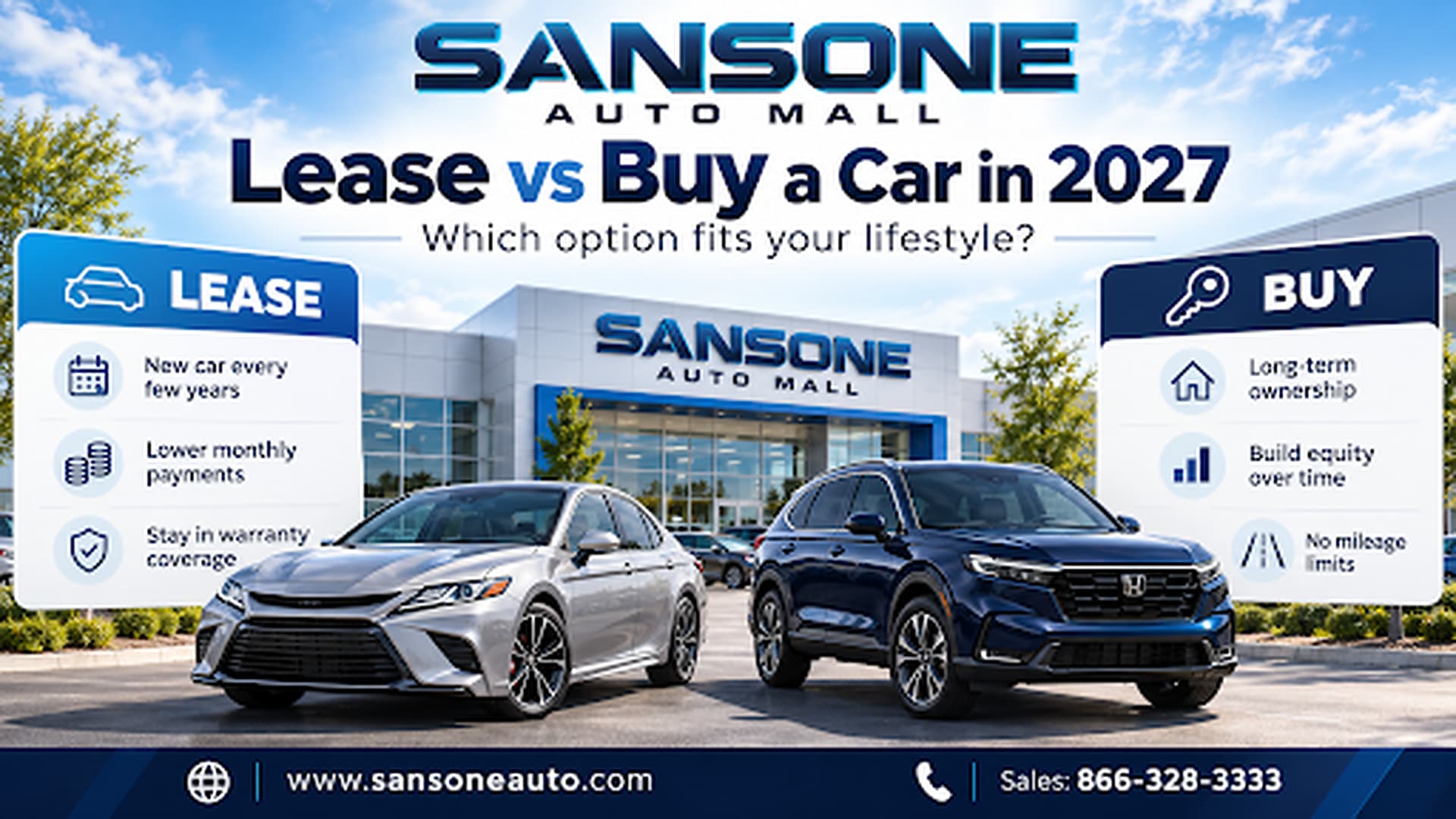
Lease vs Buy a Car in 2027: What Actually Makes Sense Right Now

Neither leasing nor buying is universally the right call. The answer depends on how many miles you drive, how long you keep your cars, and whether building equity matters to your financial picture. What has changed recently is the math. Payments on both sides have shifted, the gap between lease and loan costs has narrowed, and the choice is less obvious than it used to be. Here's a straightforward breakdown of what each option actually costs, what you give up, and how to figure out which one fits your situation. Leasing vs Buying: The Core Difference When you lease, you pay for the depreciation of the vehicle during your contract term, plus interest and fees. You hand it back at the end and walk away with no asset. When you buy, you finance the full vehicle value, pay more per month, and own it outright once the loan is paid off. Every payment after that point costs nothing. Neither path is wrong. They serve different financial situations. Lease vs Finance: Full Comparison Factor Leasing Buying (Finance) Avg. monthly payment (2026) 617 765 Typical term 24 to 36 months 60 to 72 months Ownership at end No Yes Mileage limit 10,000 to 15,000 miles/year None Excess mileage cost 12 to 30 cents per mile Not applicable Down payment required 0 to 3,000 10 to 20% recommended Modification allowed No Yes Equity built None (unless buyout) Yes Early exit costs Often significant Possible prepayment terms Best for Lower monthly cost, new car every 2-3 years Long-term ownership, high mileage Is It Better to Lease or Buy a Car? Depends on These Four Things How many miles do you drive? Most leases cap you at 10,000 to 15,000 miles per year. Excess miles cost 12 to 30 cents each, and those charges add up quickly. If you're doing long NJ commutes, covering multiple counties weekly, or taking regular road trips, buying almost always works out to be cheaper once you factor in overage penalties. How long do you keep your cars? Leasing makes financial sense if you want a new vehicle every two to three years without the hassle of selling. If you typically keep a car for seven or more years, buying is almost always the better financial outcome. The loan ends; lease payments don't. Does equity matter to you? A leased vehicle builds no equity. When the contract ends, you have no asset. With a purchase loan, every payment moves you closer to owning something outright, and that asset can be sold or traded when you're ready to move on. What's your credit situation? Lease approvals tend to require stronger credit, and the best lease terms go to buyers at the top end of the credit range. If your credit score is below 700, financing may be more accessible and may offer better terms than a lease. Leasing vs Buying in NJ: What's Different Here New Jersey has some of the highest vehicle registration and insurance costs in the country. A few things worth knowing: NJ charges sales tax on the full vehicle price even for leases, unlike some states that only tax monthly payments. This affects your total cost calculation. Long commute corridors (Route 1, Route 9, the Turnpike) and NJ's dense suburban-to-urban mix put real miles on vehicles. Buyers who commute daily often exceed standard lease mileage caps faster than they expect. If you plan to use a vehicle for a business registered in NJ, lease payments may be partially deductible as a business expense. Confirm with a tax professional before making a decision based on this. When Leasing Makes More Sense You want lower monthly payments and don't mind not building equity. You drive fewer than 12,000 miles per year. You prefer a new vehicle every two to three years without the process of selling your old one. You want to stay in warranty coverage and avoid maintenance costs for unexpected repairs. You're buying for a business and plan to write off the payment as an operating expense. When Buying Makes More Sense You drive high annual mileage and a mileage cap would cost you in overages. You plan to keep the vehicle for five or more years. Building equity and owning an asset matters to your financial plan. You want the freedom to modify, customize, or repurpose the vehicle without restrictions. You're buying used, where lease options are limited and financing rates on certified pre-owned vehicles can be competitive. Talk It Through at Sansone Auto, Woodbridge NJ The right call between leasing and buying depends on specifics: your credit, your mileage, your timeline, and what's currently available in inventory. The finance team at Sansone Auto located at 90-100 Route 1 North, Woodbridge, NJ 07001, can walk you through current lease offers and loan rates on the brands they carry and help you model out what each option actually costs for the vehicle you're considering. FAQs Is it better to lease or buy a car in 2027? It depends on your driving habits and financial priorities. Leasing offers lower monthly payments and a new vehicle every few years, but builds no equity. Buying costs more per month but ends with an owned asset. High-mileage drivers and long-term owners almost always come out ahead with financing. What is the difference between a car lease and car finance? When you lease, you pay for the vehicle's depreciation over your contract term and return it at the end. When you finance, you borrow the full purchase price and own the car once the loan is paid off. Lease terms typically run 24 to 36 months; loan terms typically run 60 to 72 months. How much does it cost to go over mileage on a lease? Most leases charge between 12 and 30 cents per excess mile, depending on the brand and contract terms. On a 36-month lease with a 12,000-mile annual cap, going 5,000 miles over your limit could add 600 to 1,500 to your final bill. Can you negotiate a lease in NJ? Yes. The capitalized cost (selling price), money factor (lease interest rate), and mileage cap are all negotiable. Getting the vehicle price down before you discuss lease terms has the biggest impact on your monthly payment. Where can I lease or finance a car in Woodbridge, NJ? Sansone Auto Group at 90-100 Route 1 North, Woodbridge, NJ 07001 carries inventory across multiple brands with both lease and financing options. Call 866-328-3333 or visit sansoneauto.com to explore current offers.

best work trucks 2026

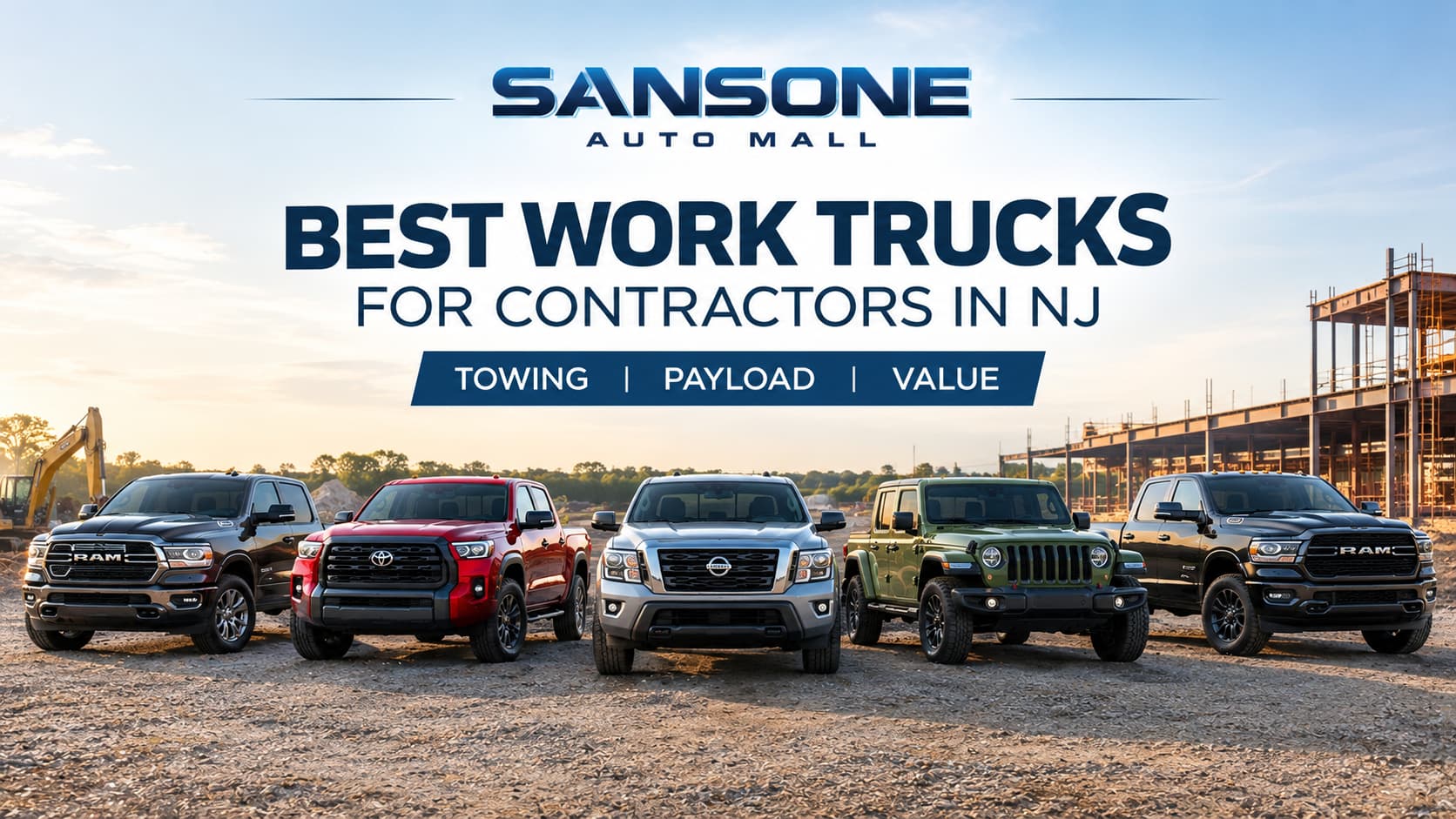
Best Trucks for Contractors in NJ (2027): Towing, Payload and Value

Your truck is your business partner. It carries your crew, your tools, and whatever lands in the bed after a long day on a NJ job site. Getting the right one means skipping the commercials and reading the actual specs: towing capacity, payload rating, and whether the truck fits the realities of working in a state that mixes suburban driveways with rural county roads. Specs below are sourced directly from official manufacturer websites. Confirm model-year availability and configurations with Sansone Auto in Woodbridge, NJ before purchase. Top 5 Best Trucks For Contractors in NJ (2027) 2026 RAM 1500 Maximum available towing capacity: up to 11,610 lbs Maximum available payload: up to 2,360 lbs Engine options: 3.6L Pentastar V6, 5.7L HEMI V8, and two versions of the 3.0L Hurricane twin-turbo inline-six High-output Hurricane inline-six produces up to 540 horsepower and 521 lb-ft of torque RAM Professional includes commercial financing, upfit support, and BusinessLink services for fleet buyers Select 2026 models qualify for a 10-year/100,000-mile Powertrain Limited Warranty Best for: Contractors who need up to 11,610 lbs of towing capacity and 2,360 lbs of payload from a half-ton truck, with professional fleet programs behind it. 2026 RAM 2500 Maximum available diesel towing capacity: up to 20,000 lbs Maximum available gas towing capacity: up to 17,750 lbs (6.4L HEMI V8) Maximum available payload: up to 3,930 lbs (6.4L HEMI V8 gas configuration) Available High-Output 6.7L Cummins Turbo Diesel I6 produces 430 horsepower and 1,075 lb-ft of torque Tradesman trim is built for commercial use, prioritizing durability over premium features Select 2026 models qualify for a 10-year/100,000-mile Powertrain Limited Warranty Best for: Contractors who regularly haul heavy equipment trailers, bulk materials, or loads that exceed the practical capacity of a half-ton truck. 2025 Toyota Tundra The SR trim comes with a 3.4L twin-turbocharged V6 producing 358 horsepower and 406 lb-ft of torque. Other non-hybrid trims offer 389 horsepower and 479 lb-ft of torque, while the i-FORCE MAX hybrid produces 437 horsepower and 583 lb-ft of torque. Paired with a 10-speed automatic transmission Maximum available payload: up to 1,940 lbs, depending on configuration. Maximum available towing capacity: up to 12,000 lbs, depending on configuration. Resale value and long-term maintenance costs are important factors for contractors evaluating the Tundra as a fleet vehicle. Best for: Contractors building a commercial fleet who are evaluating long-term ownership costs, resale prospects, and whether the Tundra's towing and payload ratings meet their requirements. 2027 Nissan Frontier Maximum available towing capacity: up to 7,150 lbs Maximum available payload: up to 1,590 lbs Engine: 3.8L V6 producing 310 horsepower and 281 lb-ft of torque. PRO-4X trim includes electronic locking rear differential, Bilstein off-road shocks, and skid plates Smaller footprint than full-size trucks makes it easier to navigate tight North Jersey neighborhoods Best for: Electricians, HVAC technicians, and finish contractors who spend most of their day on suburban job sites and don't need full-size towing capacity. 2026 Jeep Gladiator Maximum available towing capacity: up to 7,700 lbs, depending on configuration. Maximum available payload: up to 1,720 lbs on the Sport S 4x4 trim 5-foot steel bed with integrated tie-downs and an easy-lift tailgate Rubicon and Mojave trims include 33-inch all-terrain tires and steel skid plates as standard equipment Best for: Landscapers, site survey crews, and contractors who need to access hillside lots, rough terrain, and unpaved driveways. Contractor Truck Comparison: Quick Reference Truck Max Towing Max Payload Engine Best For 2026 RAM 1500 11,610 lbs 2,360 lbs 3.0L Hurricane / 5.7L HEMI V8 / 3.6L V6 Light-to-medium contractor work 2026 RAM 2500 Up to 20,000 lbs (diesel Up to 3,600 lbs (diesel), up to 3,930 lbs (gas) 6.7L High-Output Cummins Turbo Diesel I6 / 6.4L HEMI V8 Heavy hauling and equipment transport 2025 Toyota Tundra Confirm w/ dealer 2,140 lbs 3.4L Twin-Turbo V6 Long-term fleet reliability 2027 Nissan Frontier 7,150 lbs 1,590 lbs 310 hp V6 Urban job sites, specialty trades 2026 Jeep Gladiator 7,700 lbs 1,720 lbs Gas V6 Off-road and rural site access Find Your Next Work Truck at Sansone Auto The Sansone Auto Group located at 90-100 Route 1 North, Woodbridge, NJ 07001 carries inventory across RAM, Toyota, Nissan, Jeep, and other brands. We have a team that understands what NJ contractors are actually looking for in a work vehicle. Stop by or call to explore current inventory, fleet programs, and financing options. FAQs What is the best work truck for a contractor in NJ in 2027? For most contractors, the 2026 RAM 1500 offers the strongest combination of towing capacity (up to 11,610 lbs), payload (up to 2,360 lbs), and fleet programs through RAM Professional. Contractors who regularly haul beyond 12,000 lbs should look at the RAM 2500, which reaches up to 20,000 lbs of diesel towing capacity with the available 6.7L Cummins. How much towing capacity does a contractor truck need? The towing capacity a contractor needs depends on the loaded trailer, equipment, materials, passengers, and the truck's applicable weight ratings. Check the actual trailer weight against the selected truck's rated towing capacity before choosing a vehicle. Contractors transporting heavy equipment trailers or compact excavators should target trucks rated above 12,000 lbs and look at the RAM 1500 or RAM 2500 for that range. Is the RAM 1500 or Toyota Tundra better for contractor use? The 2026 RAM 1500 offers maximum available towing capacity of up to 11,610 lbs and payload of up to 2,360 lbs. The 2025 Toyota Tundra offers maximum available towing capacity of up to 12,000 lbs and payload of up to 1,940 lbs. The better choice depends on the specific configuration, load requirements, and long-term ownership costs. Is the Nissan Frontier a good truck for contractors? Yes, for the right type of work. The 2027 Frontier tows up to 7,150 lbs and carries up to 1,590 lbs of payload, covering most specialty trade needs. Its smaller footprint is a genuine advantage for anyone navigating tight residential job sites in North and Central Jersey daily. Where can NJ contractors find work trucks near Woodbridge? Sansone Auto Group in Woodbridge carries inventory across RAM, Toyota, Nissan, Jeep, and other brands. The dealership is at 90-100 Route 1 North, Woodbridge, NJ 07001. Reach the team at 866-328-3333 or browse inventory at sansoneauto.com.