Blog / Sansone Auto

Blog

All Sansone Auto North Avenel Used Cars Finance Low-Mileage Cars Sansone Auto Service Auto Parts Jeep Grand Cherokee New Inventory Jeep Information Nissan Information Nissan Rogue Ram 1500 Hyundai Tucson Jeep Compass Kia Information North Avenel Chrysler Service Commercial Inventory Grand Wagoneer Hyundai Elantra Hyundai Information Hyundai IONIQ Hyundai Kona Hyundai Palisade Hyundai Santa Fe Jeep Grand Cherokee 4xe Jeep Wrangler Kia K5 Kia Sorento Kia Sorento Hybrid Kia Sportage Mazda CX-5 Mazda CX-50 Mazda Information Nissan Altima Nissan Kicks North Avenel Chrysler Dealer Toyota bZ Woodland Toyota Camry SE Toyota Corolla Toyota RAV4 Hybrid Toyota Tacoma
A car for lease

Pros and Cons of Leasing a Car in NJ: What Buyers Need to Know in 2027

Leasing gets brought up a lot when monthly payment is the main concern. The numbers look better on paper than a purchase loan for the same vehicle, and that is what pulls most people toward it. What the payment does not show is the full picture of what you are agreeing to, what it will cost at the end of the term, and whether the structure actually fits how you use a vehicle day to day. This guide covers how leasing works, where the real costs show up, and how to figure out whether a lease or a purchase makes more sense for your situation in 2027. How Leasing Works? When you lease a car, you pay for its expected depreciation during the lease term, plus a rent charge (financing cost), applicable taxes, and fees. The leasing company establishes the vehicle's residual value, which is its projected value at the end of the lease. The monthly payment is generally calculated using the vehicle's adjusted capitalized cost, residual value, rent charge, and applicable taxes and fees. At the end of the lease, you can typically return the vehicle, purchase it if your agreement includes a purchase option, or enter a new lease. Additional charges may apply for excess mileage, excessive wear, and applicable disposition fees. The Pros of Leasing Lower monthly payments are the main draw. Because payments only cover depreciation rather than the full vehicle cost, they run lower than a comparable purchase loan. For buyers focused on monthly budget, lease deals open up vehicles and trim levels that might otherwise be out of reach. Other advantages: New vehicle every 24 to 36 months with updated safety features, tech, and fuel economy Many new-car leases are structured to keep the vehicle within its manufacturer's warranty period, although warranty coverage depends on the vehicle, lease duration, mileage, and specific warranty terms. Maintenance and certain repairs may still be your responsibility You generally do not need to negotiate a trade-in value when returning a leased vehicle. However, you may still owe charges for excess mileage, excessive wear, or other contractually specified fees. Lower upfront costs compared to a purchase down payment in many cases Sales tax treatment on leased vehicles varies by state. Some states tax individual lease payments, while others calculate tax using the vehicle's purchase price or total lease payments. Car lease offers from manufacturers sometimes include incentivized money factors that make specific models especially competitive during promotional windows The Cons of Leasing No equity at lease end is the core trade-off. When a purchase loan is paid off, you own the vehicle. When a lease ends, you have made every payment and own nothing. For buyers who lease one vehicle after another, monthly payments continue indefinitely. Other downsides: Most standard vehicle leases include annual mileage limits, commonly ranging from 10,000 to 15,000 miles, although higher-mileage options may be available at an additional cost. Excess-mileage charges vary by leasing company, vehicle, and contract. Check the per-mile charge specified in your lease agreement before signing. Excessive wear and tear beyond the leasing company's acceptable-use standards may result in additional charges at lease return. Any security deposit is handled according to the terms of the lease agreement. Early termination penalties can be close to what it would have cost to finish the lease Vehicle modifications may be restricted by the lease agreement. You may be required to remove unauthorized modifications and restore the vehicle before returning it. Over the long term, repeatedly leasing vehicles can cost more than purchasing and keeping a vehicle for several years, although the overall financial outcome depends on purchase price, financing costs, depreciation, maintenance, and lease incentives. Leasing vs. Buying: A Quick Comparison Factor Leasing Buying Monthly payment Lower Higher Ownership None during term Builds over time Mileage 10,000 to 12,000/year typical No limit Customization Not permitted Permitted End of term Return, buy, or re-lease Vehicle is paid off Long-term cost Higher if leasing consecutively Lower if keeping vehicle long term Repair exposure Covered by warranty during lease Increases after warranty expires When Leasing Makes Sense Leasing fits a specific profile. If the following apply to you, a lease is worth seriously comparing against a purchase: You drive under 12,000 miles per year You keep vehicles in good condition with minimal interior or exterior damage You prefer having a current model year with up-to-date features every few years Your budget benefits more from lower monthly payments than from building equity You use the vehicle for qualifying business purposes and may be eligible to deduct the business-use portion of lease expenses, subject to IRS rules, business-use percentages, and applicable tax limitations. Consult a tax professional. When Buying Makes More Sense Buying is the better financial outcome for buyers who keep vehicles for six or more years, drive high annual mileage, or want full freedom over how the vehicle is used and maintained. Consider buying if: You regularly drive more than the mileage allowance in a standard lease. Excess-mileage charges can reduce or eliminate the financial savings of leasing, so compare higher-mileage lease options with purchasing. You want to modify the vehicle or use it for heavy hauling You plan to keep the vehicle beyond five years, at which point loan payments stop entirely You want to avoid the inspection and condition requirements that come with every lease return Building equity or owning the vehicle outright matters to your financial goals What to Watch For in Any Lease Agreement Before signing a lease on any vehicle, ask the dealer for these figures specifically: Money factor: The financing component of a lease, expressed as a decimal. Multiply it by 2,400 to estimate the equivalent APR. This is a common industry conversion, not an exact comparison of all financing costs. Residual value: the projected value of the vehicle at lease end. Higher residuals mean lower payments. Acquisition fee: A fee charged by the leasing company to arrange the lease. The amount varies by lender and may be paid upfront or included in the amount financed. Disposition fee: A fee that may be charged when you return the leased vehicle without purchasing it. The amount and any applicable waivers depend on the leasing company's contract and policies. Total drive-off amount: everything due at signing, not just the first month’s payment The advertised monthly payment on car lease offers does not reflect all of these costs. The total drive-off and the fees at return are what determine the actual cost of the lease. Find Lease Deals at Sansone Auto Group in New Jersey If you are ready to explore your options for a car for lease in New Jersey, Sansone Auto Group is the place to start. It is conveniently located at 90-100 Route 1 North, Woodbridge, NJ 07001. Sansone Auto Group represents Toyota, Kia, Hyundai, Nissan, Mazda, Chrysler, Jeep, Dodge, and RAM, with multiple dealerships operating at its Woodbridge location. Its team can help you explore available manufacturer lease offers, compare leasing and purchasing options, and evaluate financing structures based on your budget and driving habits. Call 866-328-3333 or visit sansoneauto.com to get started. FAQs What is a car for lease versus buying? Leasing means paying for depreciation over the term, not the full vehicle. Payments are lower, but you own nothing at the end. Buying means higher payments and eventual ownership once the loan is paid off. Are Toyota lease deals worth considering? They can be, especially when Toyota is running promotional money factors on specific models. Compare the total lease cost against a purchase loan over the same number of years before deciding. Mileage is the biggest variable. What should I look for in car lease offers? Money factor, residual value, acquisition fee, disposition fee, and total drive-off amount. The advertised monthly payment does not include all of these. Ask the dealer to break each one out before signing. What are automatic lease deals? Automatic lease deals generally refer to leasing offers on vehicles equipped with automatic transmissions. These are not a separate financing category; the lease terms depend on the vehicle, manufacturer incentives, leasing company, mileage allowance, and credit approval. What should NJ drivers know about leasing? New Jersey commuters, particularly those traveling regularly into the New York City metropolitan area, should estimate their annual mileage carefully before choosing a lease. Longer commutes can make standard mileage allowances insufficient. If you are regularly above 12,000 miles per year, lease overage charges can add up fast. New Jersey sales tax on long-term vehicle leases can be calculated using either the lessor's original purchase price or the total lease payments, subject to applicable tax rules.
common car buying mistakes

10 Common Car Buying Mistakes to Avoid in New Jersey

Buying a car in NJ sounds straightforward. That is, until you’re sitting across a desk trying to decode a contract you’ve never seen before. Most costly car dealership mistakes happen before the paperwork even starts, during research, the financing conversation, or when a dealer slides in add-ons. 10 Common Car Buying Mistakes To Avoid Here are ten common car-buying mistakes New Jersey shoppers should avoid, along with relevant consumer-protection rules and practical steps to help them make informed decisions. Focusing on the Monthly Payment Instead of the Total Price This is one of the most common car buying mistakes across every budget range. A dealer may offer a longer loan term, such as 84 months instead of 48 months, to reduce the monthly payment. However, if the loan amount and APR remain the same, extending the repayment period generally increases the total interest paid and keeps the buyer in debt for longer. Ask for the complete out-the-door price before any payment is discussed. A longer loan term also means you may owe more than the car is worth for the first few years, which creates problems if you need to trade or sell early. Get the total financed amount in writing alongside the monthly figure so you can compare them accurately. Skipping Pre-Approval Before You Shop Shopping for a car without arranging financing in advance can make it harder to judge whether a dealer's financing offer is competitive. AAA recommends getting pre-approved through a bank or credit union before visiting a dealership. This gives buyers an independent rate benchmark to compare against dealer financing. Pre-approval gives you a rate benchmark so you can evaluate dealer financing on its actual merits. It also keeps negotiations focused on the vehicle price rather than monthly payment terms. Dealer financing can be competitive, but you need a number to compare it against. Not Doing Research Before You Visit One of the most avoidable car dealership mistakes is arriving without knowing what the vehicle should cost or what features come standard. Before visiting a dealership, research its reputation, read customer reviews and check whether the New Jersey Division of Consumer Affairs has published enforcement actions or other relevant consumer-protection information about the business. Use official manufacturer websites to confirm standard features and available trim differences. Check the dealer’s record through the NJ Division of Consumer Affairs before visiting. Shoppers who research first negotiate from a position of knowledge rather than curiosity. Agreeing to Dealer Add-Ons Without Asking About Each One Paint protection, VIN etching, nitrogen tire fills, and fabric coating packages are routinely added to deals without much explanation. New Jersey's automotive sales regulations prohibit dealers from misrepresenting optional aftermarket products, such as service contracts or window etching, as mandatory. Dealers must also accurately disclose the prices of dealer-installed options and itemise applicable aftermarket merchandise in sales documents and contracts. Ask for a complete itemized list of every add-on in your deal before you sign. If an add-on was not part of your original negotiation, ask for it to be removed or clearly explained. Some protective coatings and service packages are available elsewhere for significantly less. Ignoring New Jersey’s Hidden Car Buying Costs Protections Hidden car buying costs are a documented issue in NJ. The state Attorney General has issued enforcement guidance confirming that certain fee practices already violate the Consumer Fraud Act. New Jersey has taken enforcement action against dealerships for advertising vehicle prices that exclude required dealer fees and for other misleading pricing practices. Loan packing, adding products to a loan without the consumer's informed consent, is another serious consumer-protection concern. Ask for an itemised breakdown of the vehicle price, dealer fees, optional products and financing costs before signing. Review every line of the price breakdown before signing, not just the summary page. If fees appear that were not part of your negotiation, ask what each one covers. New Jersey's Consumer Fraud Act authorizes civil penalties of up to $10,000 for a first violation and up to $20,000 for subsequent violations. Whether a practice violates the law depends on the applicable legal requirements and facts of the case; consumers should not assume that every unexpected fee automatically constitutes fraud. Rushing Through the Contract This is where many hidden car buying costs slip through. NJ consumer protection guidance specifically flags contracts where the signed terms differ from what was verbally agreed. Read every section carefully, including any digital contract terms. Under New Jersey's Consumer Protection Leasing Act, consumers are entitled to review a vehicle lease contract for one 24-hour business day before signing. This is a pre-signing review period, not a general right to cancel a signed vehicle purchase or lease. Confirm every agreed-upon price, rate, and term is reflected in writing before you sign anything. Not Accounting for All the Costs of Buying a Car in NJ The purchase price is only one part of what you will spend. Many buyers make the mistake of budgeting only for the vehicle and are caught off guard by what comes after. Hidden car buying costs to plan for when buying a car in NJ: New Jersey sales tax: 6.625% on vehicle purchases Registration and title fees Auto insurance, which can vary significantly depending on the vehicle Routine maintenance and any anticipated repairs Fuel costs, particularly if you are stepping up from a more efficient vehicle Making a Decision Under Pressure High-pressure tactics are specifically flagged by New Jersey’s Division of Consumer Affairs as a consumer warning sign. Urgency around inventory, same-day pricing, and rushed signings are designed to prevent you from comparing options or reviewing terms. Any deal that requires an immediate decision is worth slowing down on. Take contracts home to review if you need time. You are entitled to read what you are signing. Do not let time pressure prevent you from comparing offers or reviewing the contract. Skipping a Vehicle History Check on a Used Car Before buying a used car in New Jersey, check the state's available flood- and salvage-title records by VIN and obtain a vehicle history report. These checks can help identify title issues, but they should not replace an independent inspection or a review of the vehicle's full history. NHTSA also maintains a free recall lookup tool at nhtsa.gov. Run the VIN through NHTSA’s recall database before finalizing any used car purchase. Ask for service records and confirm the title is clear. For used vehicles, a pre-purchase inspection by an independent mechanic is one of the most valuable steps a buyer can take before committing. Letting Emotion Drive the Buying Decision One of the most common car buying mistakes has nothing to do with paperwork. Buyers frequently choose a vehicle based on how it looks or feels rather than whether it fits their actual budget and needs. According to Money, this mismatch shows up quickly once ownership costs start coming in. Set your must-haves before you start shopping and hold to them during the visit. If a vehicle does not meet your practical and financial criteria, keep looking. A car that works for your life will serve you better than one that does not, regardless of the showroom experience. New vs. Used Car Buying Considerations in NJ Factor New Vehicle Used Vehicle NJ Lemon Law coverage Yes, covers serious unresolved defects Potentially, for eligible vehicles meeting New Jersey’s age, mileage, price, and other legal requirements. Dealer add-on risk High High Vehicle history transparency Full from manufacturer Requires VIN and history check Pre-purchase inspection Optional Strongly recommended Recall check via NHTSA Recommended Strongly recommended. Check the VIN for unrepaired safety recalls. Lease contract review period 24-hour business day Depends on deal type Find Your Next Car in New Jersey Without the Runaround If you are ready to buy in New Jersey, Sansone Auto Group is the place to start. It is conveniently located at 90-100 US Highway 1 North, Woodbridge, NJ 07001. The team works across multiple brands and can walk you through current inventory, explain every cost in your deal, and help you avoid the car dealership mistakes and hidden car buying costs that catch most shoppers off guard. FAQs What are the most common car buying mistakes in New Jersey? Common mistakes include focusing only on the monthly payment, skipping financing pre-approval, accepting dealer add-ons without questioning them, and not accounting for hidden costs like NJ sales tax, registration fees, and insurance. Rushing through a contract without reading it is also a frequently cited issue. What hidden car buying costs should I expect when buying a car in NJ? Budget for New Jersey sales tax, generally 6.625% of the taxable purchase price, along with applicable title and registration fees, insurance and ongoing ownership costs. Ask for an itemised out-the-door price that identifies dealer fees and optional add-ons separately. Optional products should not be presented as mandatory unless there is a valid basis for doing so. What car dealership mistakes does NJ law protect against? New Jersey's consumer-protection laws and automotive sales regulations address misleading advertised prices, undisclosed charges, unauthorised or misrepresented add-on products, and other deceptive sales practices. Whether a particular transaction violates the law depends on the facts and the applicable requirements. Should I get pre-approved before visiting a dealership in NJ? Yes. Getting pre-approved through a bank or credit union gives you a financing benchmark to compare with a dealership's offer. It can help you negotiate the vehicle price separately from the financing terms, but you should still compare APR, loan length, fees and total repayment cost before choosing a loan. Does New Jersey have a Lemon Law? Yes. New Jersey has separate Lemon Laws for qualifying new and used vehicles. New-car coverage generally requires a qualifying defect reported within the first 24,000 miles of operation or two years after original delivery, whichever occurs first. Used-car coverage depends on specific eligibility and warranty requirements.

Leasing vs buying a car

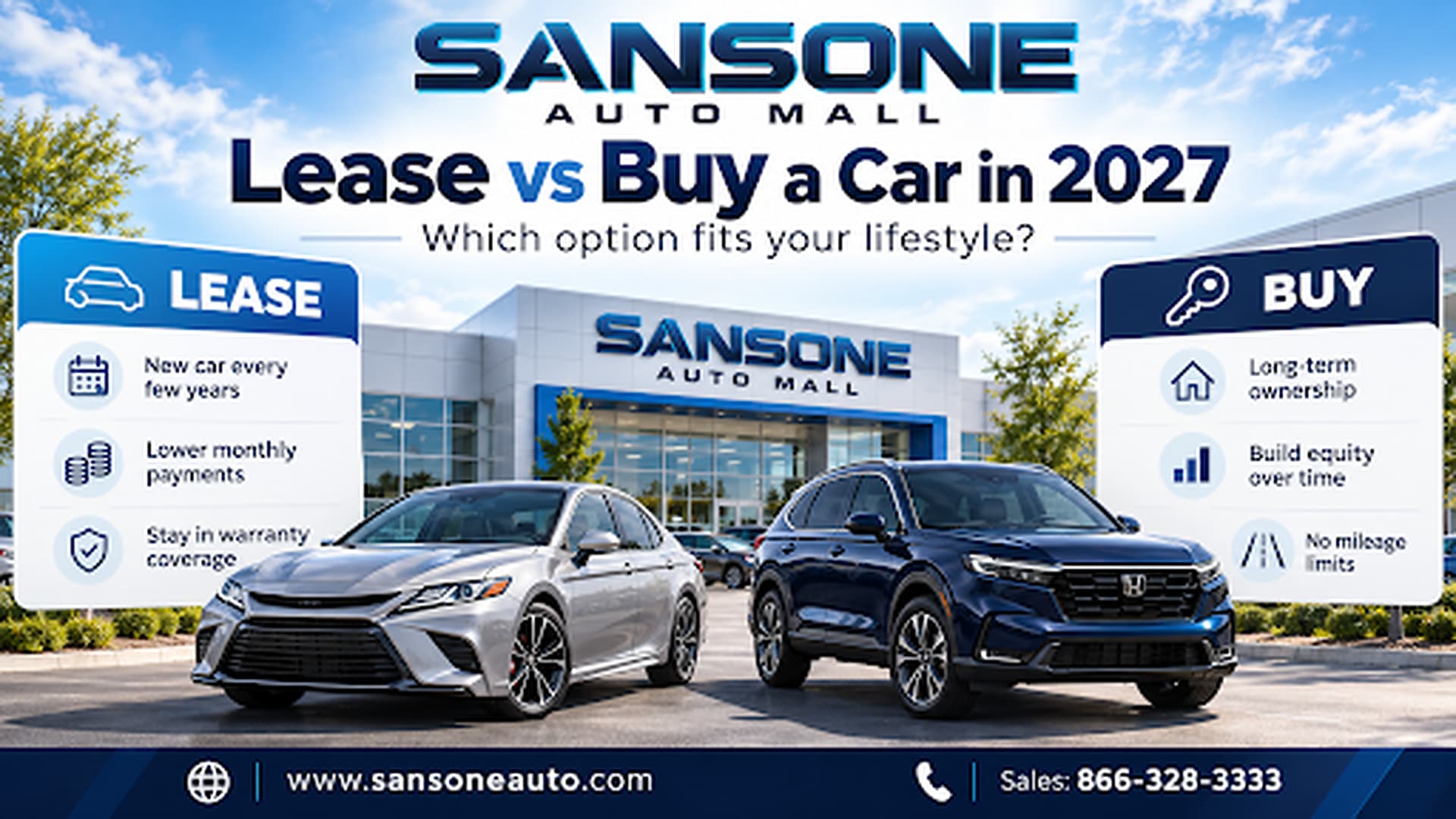
Lease vs Buy a Car in 2027: What Actually Makes Sense Right Now

Neither leasing nor buying is universally the right call. The answer depends on how many miles you drive, how long you keep your cars, and whether building equity matters to your financial picture. What has changed recently is the math. Payments on both sides have shifted, the gap between lease and loan costs has narrowed, and the choice is less obvious than it used to be. Here's a straightforward breakdown of what each option actually costs, what you give up, and how to figure out which one fits your situation. Leasing vs Buying: The Core Difference When you lease, you pay for the depreciation of the vehicle during your contract term, plus interest and fees. You hand it back at the end and walk away with no asset. When you buy, you finance the full vehicle value, pay more per month, and own it outright once the loan is paid off. Every payment after that point costs nothing. Neither path is wrong. They serve different financial situations. Lease vs Finance: Full Comparison Factor Leasing Buying (Finance) Avg. monthly payment (2026) 617 765 Typical term 24 to 36 months 60 to 72 months Ownership at end No Yes Mileage limit 10,000 to 15,000 miles/year None Excess mileage cost 12 to 30 cents per mile Not applicable Down payment required 0 to 3,000 10 to 20% recommended Modification allowed No Yes Equity built None (unless buyout) Yes Early exit costs Often significant Possible prepayment terms Best for Lower monthly cost, new car every 2-3 years Long-term ownership, high mileage Is It Better to Lease or Buy a Car? Depends on These Four Things How many miles do you drive? Most leases cap you at 10,000 to 15,000 miles per year. Excess miles cost 12 to 30 cents each, and those charges add up quickly. If you're doing long NJ commutes, covering multiple counties weekly, or taking regular road trips, buying almost always works out to be cheaper once you factor in overage penalties. How long do you keep your cars? Leasing makes financial sense if you want a new vehicle every two to three years without the hassle of selling. If you typically keep a car for seven or more years, buying is almost always the better financial outcome. The loan ends; lease payments don't. Does equity matter to you? A leased vehicle builds no equity. When the contract ends, you have no asset. With a purchase loan, every payment moves you closer to owning something outright, and that asset can be sold or traded when you're ready to move on. What's your credit situation? Lease approvals tend to require stronger credit, and the best lease terms go to buyers at the top end of the credit range. If your credit score is below 700, financing may be more accessible and may offer better terms than a lease. Leasing vs Buying in NJ: What's Different Here New Jersey has some of the highest vehicle registration and insurance costs in the country. A few things worth knowing: NJ charges sales tax on the full vehicle price even for leases, unlike some states that only tax monthly payments. This affects your total cost calculation. Long commute corridors (Route 1, Route 9, the Turnpike) and NJ's dense suburban-to-urban mix put real miles on vehicles. Buyers who commute daily often exceed standard lease mileage caps faster than they expect. If you plan to use a vehicle for a business registered in NJ, lease payments may be partially deductible as a business expense. Confirm with a tax professional before making a decision based on this. When Leasing Makes More Sense You want lower monthly payments and don't mind not building equity. You drive fewer than 12,000 miles per year. You prefer a new vehicle every two to three years without the process of selling your old one. You want to stay in warranty coverage and avoid maintenance costs for unexpected repairs. You're buying for a business and plan to write off the payment as an operating expense. When Buying Makes More Sense You drive high annual mileage and a mileage cap would cost you in overages. You plan to keep the vehicle for five or more years. Building equity and owning an asset matters to your financial plan. You want the freedom to modify, customize, or repurpose the vehicle without restrictions. You're buying used, where lease options are limited and financing rates on certified pre-owned vehicles can be competitive. Talk It Through at Sansone Auto, Woodbridge NJ The right call between leasing and buying depends on specifics: your credit, your mileage, your timeline, and what's currently available in inventory. The finance team at Sansone Auto located at 90-100 Route 1 North, Woodbridge, NJ 07001, can walk you through current lease offers and loan rates on the brands they carry and help you model out what each option actually costs for the vehicle you're considering. FAQs Is it better to lease or buy a car in 2027? It depends on your driving habits and financial priorities. Leasing offers lower monthly payments and a new vehicle every few years, but builds no equity. Buying costs more per month but ends with an owned asset. High-mileage drivers and long-term owners almost always come out ahead with financing. What is the difference between a car lease and car finance? When you lease, you pay for the vehicle's depreciation over your contract term and return it at the end. When you finance, you borrow the full purchase price and own the car once the loan is paid off. Lease terms typically run 24 to 36 months; loan terms typically run 60 to 72 months. How much does it cost to go over mileage on a lease? Most leases charge between 12 and 30 cents per excess mile, depending on the brand and contract terms. On a 36-month lease with a 12,000-mile annual cap, going 5,000 miles over your limit could add 600 to 1,500 to your final bill. Can you negotiate a lease in NJ? Yes. The capitalized cost (selling price), money factor (lease interest rate), and mileage cap are all negotiable. Getting the vehicle price down before you discuss lease terms has the biggest impact on your monthly payment. Where can I lease or finance a car in Woodbridge, NJ? Sansone Auto Group at 90-100 Route 1 North, Woodbridge, NJ 07001 carries inventory across multiple brands with both lease and financing options. Call 866-328-3333 or visit sansoneauto.com to explore current offers.

best work trucks 2026

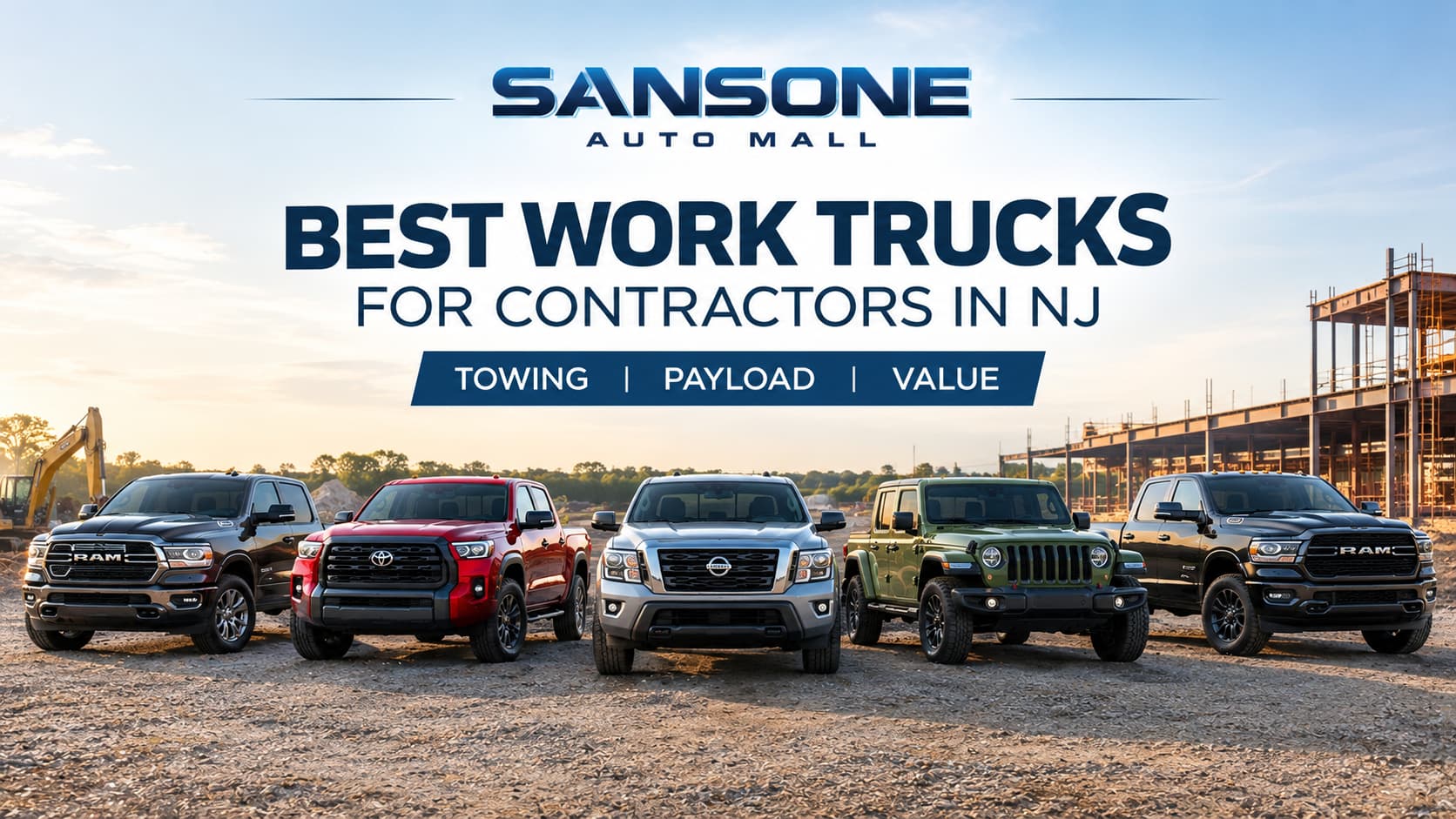
Best Trucks for Contractors in NJ (2027): Towing, Payload and Value

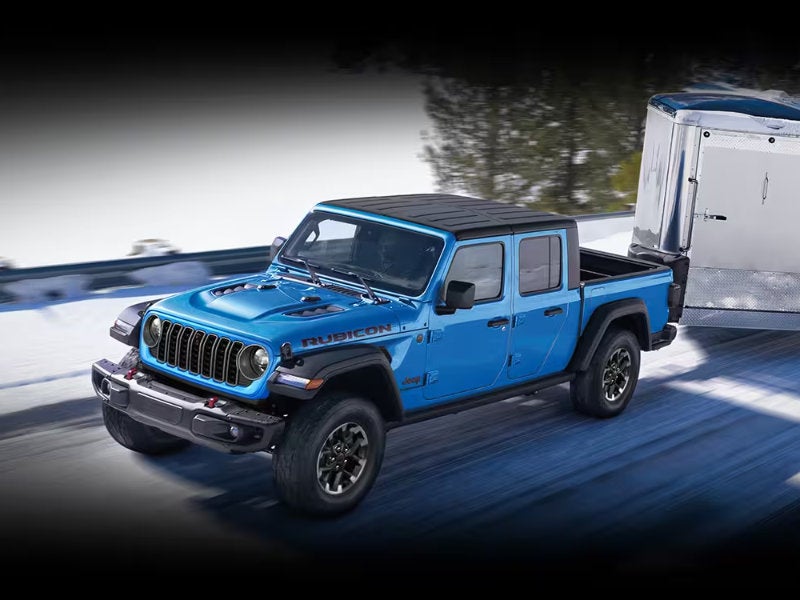
Your truck is your business partner. It carries your crew, your tools, and whatever lands in the bed after a long day on a NJ job site. Getting the right one means skipping the commercials and reading the actual specs: towing capacity, payload rating, and whether the truck fits the realities of working in a state that mixes suburban driveways with rural county roads. Specs below are sourced directly from official manufacturer websites. Confirm model-year availability and configurations with Sansone Auto in Woodbridge, NJ before purchase. Top 5 Best Trucks For Contractors in NJ (2027) 2026 RAM 1500 Maximum available towing capacity: up to 11,610 lbs Maximum available payload: up to 2,360 lbs Engine options: 3.6L Pentastar V6, 5.7L HEMI V8, and two versions of the 3.0L Hurricane twin-turbo inline-six High-output Hurricane inline-six produces up to 540 horsepower and 521 lb-ft of torque RAM Professional includes commercial financing, upfit support, and BusinessLink services for fleet buyers Select 2026 models qualify for a 10-year/100,000-mile Powertrain Limited Warranty Best for: Contractors who need up to 11,610 lbs of towing capacity and 2,360 lbs of payload from a half-ton truck, with professional fleet programs behind it. 2026 RAM 2500 Maximum available diesel towing capacity: up to 20,000 lbs Maximum available gas towing capacity: up to 17,750 lbs (6.4L HEMI V8) Maximum available payload: up to 3,930 lbs (6.4L HEMI V8 gas configuration) Available High-Output 6.7L Cummins Turbo Diesel I6 produces 430 horsepower and 1,075 lb-ft of torque Tradesman trim is built for commercial use, prioritizing durability over premium features Select 2026 models qualify for a 10-year/100,000-mile Powertrain Limited Warranty Best for: Contractors who regularly haul heavy equipment trailers, bulk materials, or loads that exceed the practical capacity of a half-ton truck. 2025 Toyota Tundra The SR trim comes with a 3.4L twin-turbocharged V6 producing 358 horsepower and 406 lb-ft of torque. Other non-hybrid trims offer 389 horsepower and 479 lb-ft of torque, while the i-FORCE MAX hybrid produces 437 horsepower and 583 lb-ft of torque. Paired with a 10-speed automatic transmission Maximum available payload: up to 1,940 lbs, depending on configuration. Maximum available towing capacity: up to 12,000 lbs, depending on configuration. Resale value and long-term maintenance costs are important factors for contractors evaluating the Tundra as a fleet vehicle. Best for: Contractors building a commercial fleet who are evaluating long-term ownership costs, resale prospects, and whether the Tundra's towing and payload ratings meet their requirements. 2027 Nissan Frontier Maximum available towing capacity: up to 7,150 lbs Maximum available payload: up to 1,590 lbs Engine: 3.8L V6 producing 310 horsepower and 281 lb-ft of torque. PRO-4X trim includes electronic locking rear differential, Bilstein off-road shocks, and skid plates Smaller footprint than full-size trucks makes it easier to navigate tight North Jersey neighborhoods Best for: Electricians, HVAC technicians, and finish contractors who spend most of their day on suburban job sites and don't need full-size towing capacity. 2026 Jeep Gladiator Maximum available towing capacity: up to 7,700 lbs, depending on configuration. Maximum available payload: up to 1,720 lbs on the Sport S 4x4 trim 5-foot steel bed with integrated tie-downs and an easy-lift tailgate Rubicon and Mojave trims include 33-inch all-terrain tires and steel skid plates as standard equipment Best for: Landscapers, site survey crews, and contractors who need to access hillside lots, rough terrain, and unpaved driveways. Contractor Truck Comparison: Quick Reference Truck Max Towing Max Payload Engine Best For 2026 RAM 1500 11,610 lbs 2,360 lbs 3.0L Hurricane / 5.7L HEMI V8 / 3.6L V6 Light-to-medium contractor work 2026 RAM 2500 Up to 20,000 lbs (diesel Up to 3,600 lbs (diesel), up to 3,930 lbs (gas) 6.7L High-Output Cummins Turbo Diesel I6 / 6.4L HEMI V8 Heavy hauling and equipment transport 2025 Toyota Tundra Confirm w/ dealer 2,140 lbs 3.4L Twin-Turbo V6 Long-term fleet reliability 2027 Nissan Frontier 7,150 lbs 1,590 lbs 310 hp V6 Urban job sites, specialty trades 2026 Jeep Gladiator 7,700 lbs 1,720 lbs Gas V6 Off-road and rural site access Find Your Next Work Truck at Sansone Auto The Sansone Auto Group located at 90-100 Route 1 North, Woodbridge, NJ 07001 carries inventory across RAM, Toyota, Nissan, Jeep, and other brands. We have a team that understands what NJ contractors are actually looking for in a work vehicle. Stop by or call to explore current inventory, fleet programs, and financing options. FAQs What is the best work truck for a contractor in NJ in 2027? For most contractors, the 2026 RAM 1500 offers the strongest combination of towing capacity (up to 11,610 lbs), payload (up to 2,360 lbs), and fleet programs through RAM Professional. Contractors who regularly haul beyond 12,000 lbs should look at the RAM 2500, which reaches up to 20,000 lbs of diesel towing capacity with the available 6.7L Cummins. How much towing capacity does a contractor truck need? The towing capacity a contractor needs depends on the loaded trailer, equipment, materials, passengers, and the truck's applicable weight ratings. Check the actual trailer weight against the selected truck's rated towing capacity before choosing a vehicle. Contractors transporting heavy equipment trailers or compact excavators should target trucks rated above 12,000 lbs and look at the RAM 1500 or RAM 2500 for that range. Is the RAM 1500 or Toyota Tundra better for contractor use? The 2026 RAM 1500 offers maximum available towing capacity of up to 11,610 lbs and payload of up to 2,360 lbs. The 2025 Toyota Tundra offers maximum available towing capacity of up to 12,000 lbs and payload of up to 1,940 lbs. The better choice depends on the specific configuration, load requirements, and long-term ownership costs. Is the Nissan Frontier a good truck for contractors? Yes, for the right type of work. The 2027 Frontier tows up to 7,150 lbs and carries up to 1,590 lbs of payload, covering most specialty trade needs. Its smaller footprint is a genuine advantage for anyone navigating tight residential job sites in North and Central Jersey daily. Where can NJ contractors find work trucks near Woodbridge? Sansone Auto Group in Woodbridge carries inventory across RAM, Toyota, Nissan, Jeep, and other brands. The dealership is at 90-100 Route 1 North, Woodbridge, NJ 07001. Reach the team at 866-328-3333 or browse inventory at sansoneauto.com.

trade-in value dealership NJ

Trade-In Value at a Dealership in NJ: How to Get More for Your Vehicle

Most buyers think about their trade-in as a secondary detail, something to sort out after they've found the car they want. In practice, how you handle your trade-in can affect the total cost of your purchase by thousands of dollars in either direction. At a multi-brand dealership like Sansone Auto Group, with over 2,000 new and pre-owned vehicles across 10 brands, the trade-in conversation has more flexibility than it does at a single-brand store, and understanding why helps you use it. How Dealers Actually Value Your Trade-In Before you can negotiate effectively, it helps to understand what's happening behind the appraiser's offer. Every trade-in offer starts from a figure called Actual Cash Value, or ACV,  the dealer's estimate of what your vehicle is worth at wholesale right now. From there, the dealer subtracts expected reconditioning costs and a margin before arriving at the figure they present. The core inputs that drive your ACV: Year, make, and model - some vehicles hold value significantly better than others Mileage - higher miles compress the offer, particularly past 100,000 miles Condition - exterior, interior, and mechanical state, each assessed separately Accident history - pulled via VIN report; prior accidents reduce value, even repaired ones Local demand - a high-demand used vehicle on a lot that needs it gets a stronger offer than the same car in a market with oversupply The reason trade-in value is lower than private-party or retail value is structural: the dealer covers reconditioning, auction costs if the vehicle is wholesaled, and their margin to resell. Understanding this prevents you from anchoring to the retail price of a similar vehicle and feeling shortchanged, the figures represent different stages of the same transaction. What You Can Do Before the Appraisal Get at least two independent valuations first. Enter your VIN or license plate (more accurate than make/model/year alone), mileage, and honest condition assessment. The trade-in value range from both tools gives you a realistic floor for the conversation. You can also get a trade-in appraisal from Sansone Auto online before your visit, the tool gives you a real starting estimate based on your vehicle's details before you set foot on the lot. Clean the car, fix the simple things, skip the expensive ones. A detailed interior and a clean exterior signal to an appraiser that the vehicle was cared for. However, skip major mechanical repairs. Dealers recondition vehicles at internal wholesale rates, you are unlikely to recover a $1,500 repair in a higher offer. Gather your maintenance records. A documented service history gives the appraiser confidence in the vehicle's condition and can support a higher condition tier assessment. Bring whatever records you have, dealer service receipts, oil change records, any warranty documentation still in effect. Why Multi-Brand Inventory Changes the Trade-In Equation Here is the specific advantage of trading at a multi-brand group that most buyers don't think about. At a single-brand dealership, your trade-in is either useful to their used inventory or it isn't. If your vehicle doesn't fit their typical customer profile, it's likely to be wholesaled,  meaning the dealer's offer reflects auction value, not retail potential. At a dealership group with 10 brands and over 2,000 vehicles in inventory, there is a significantly wider range of buyers cycling through. A trade-in that isn't an obvious fit for one brand's customer profile may be exactly what another brand's buyer is looking for. That broader retail potential means the dealer has more reason to offer retail-adjacent value rather than defaulting to wholesale pricing on vehicles outside a narrow profile. In practical terms: if you're trading in a Honda, a Jeep, or a Toyota at Sansone, the pre-owned inventory spans enough of the market that your vehicle has a realistic path to retail resale,  which is reflected in the offer. The One Rule That Matters Most: Keep Negotiations Separate This is the most consistently cited advice from automotive industry analysts and consumer advocates, and it matters regardless of where you buy. Negotiate the price of the vehicle you're buying first, independent of your trade-in. Only after you have an agreed out-the-door price on the new vehicle should you bring your trade-in into the conversation. When both figures are negotiated together, a dealer can shift profit between them, offering more on the trade while adjusting the new vehicle price, or the reverse. Keeping them separate means you know the real value of each. The same logic applies to monthly payments. A dealer can make any number look more favorable by stretching the loan term. Always anchor your negotiation to the out-the-door total price, the full amount you will pay, including all fees, before financing. A Note on Negative Equity If you currently have a loan on your trade-in, the process has one additional step. Sansone's team can contact your lender directly to get a payoff amount. If your car is worth more than you owe, the positive equity rolls into your new purchase. If you owe more than the vehicle is worth, the gap needs to be closed with cash or rolled into your new financing. Knowing your payoff amount before you arrive gives you a clearer picture of your starting position. Start Your Trade-In Appraisal at Sansone Auto Sansone Auto Group is located at 90-100 Route 1 North, Woodbridge, NJ 07001. You can start your trade-in appraisal online before your visit to get a real estimate on your current vehicle. The team can walk through the valuation, apply it toward any vehicle across all 10 brands in inventory, and handle the lender payoff directly if your vehicle has an existing loan. FAQs How does a dealership determine my trade-in value? Dealers start from your vehicle's Actual Cash Value, a wholesale estimate based on year, make, model, mileage, condition, accident history, and current local demand. They then subtract expected reconditioning costs and a margin before presenting an offer. Should I negotiate my trade-in and new vehicle purchase at the same time? No. Industry analysts consistently recommend negotiating the out-the-door price on your new vehicle first, before introducing the trade-in. When negotiated together, profit can shift between the two figures in ways that are difficult to track. Keeping them separate gives you a clear picture of what each is actually worth. What should I do before bringing my car in for a trade-in appraisal? Clean the car thoroughly, fix inexpensive issues like burned-out lights or a cracked windshield, and gather your maintenance records. You can also get a preliminary estimate at sansoneauto.com/trade.aspx before your visit. Can I trade in a car that still has a loan on it? Yes. If the car is worth more than what you owe on it, the positive equity can be used toward your new purchase. If you owe more than the car is worth, you can either make up the difference in cash or roll it into the new loan. Sansone’s team handles the lender payoff directly. Why might I get a better trade-in offer at a multi-brand dealership? A dealership with a wide multi-brand inventory has a broader range of buyers and a higher likelihood of retailing your trade-in rather than wholesaling it. Vehicles that don't fit a single-brand profile often get lower offers because the dealer expects to send them to auction. A multi-brand group has more retail pathways for more vehicle types.

certified pre-owned vs used car

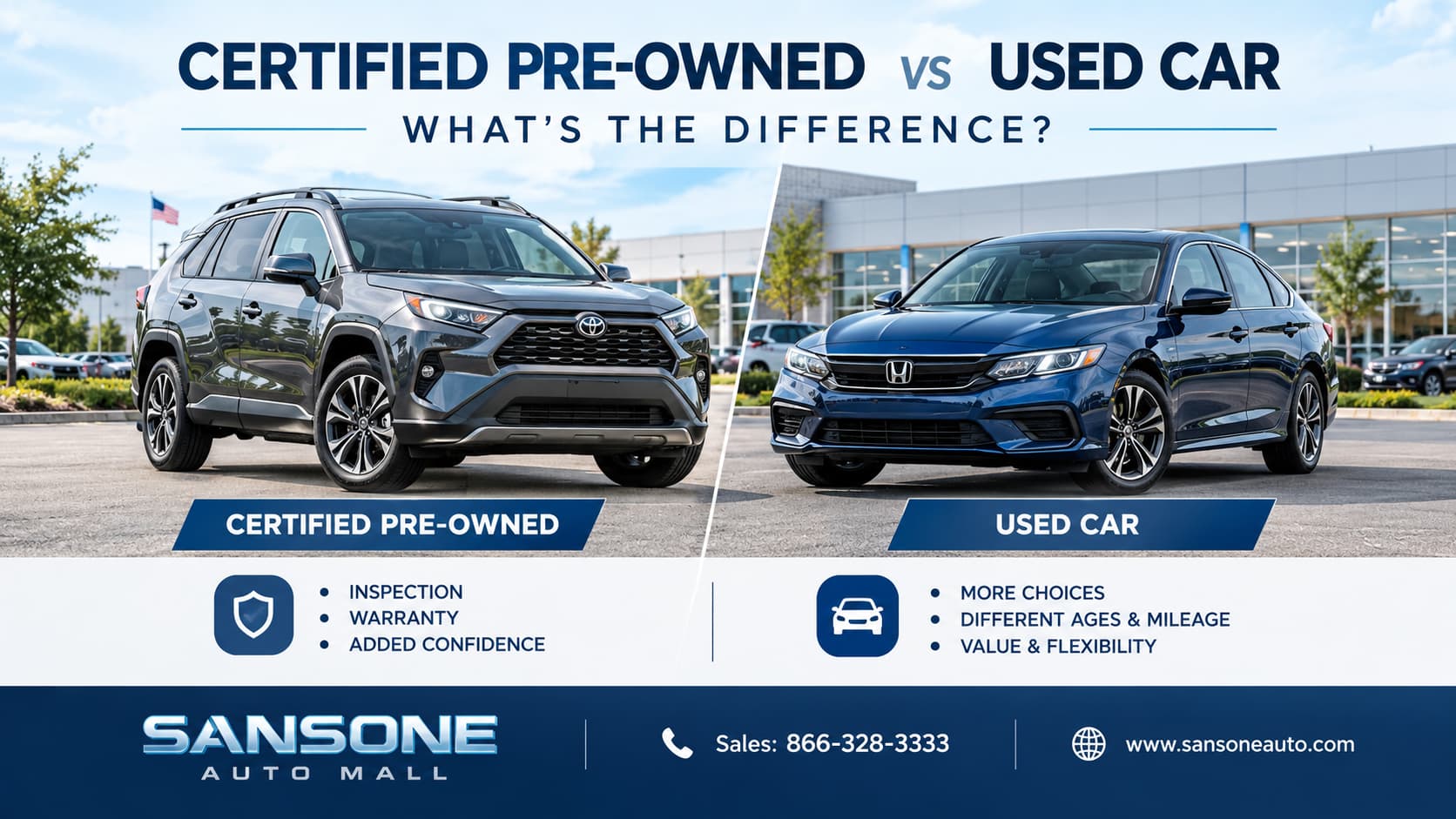
Certified Pre-Owned vs Used Car: What’s the Difference?

If you've been shopping for a pre-owned vehicle at Sansone Auto Group, you've likely seen both "used" and "certified pre-owned" listings sitting side by side, sometimes for the same make and model, at noticeably different prices. The difference isn't just marketing. It's a meaningful distinction that affects your warranty coverage, the condition of the vehicle, and your total risk as a buyer. Here's what each actually means. What Is a Regular Used Car? A used car is any vehicle that has previously been owned by someone else. That's the full definition. It could be a one-owner lease return with 18,000 miles, or a five-owner vehicle with a patchy service history. The condition, mileage, and maintenance record can vary dramatically from one used car to the next. Warranty coverage on a regular used vehicle varies. Some may be sold without additional dealer warranty coverage, while others may retain factory coverage or qualify for protections required by applicable law. Comparable non-certified used vehicles may have a lower asking price than CPO vehicles because they do not include the same manufacturer certification requirements and benefits. For buyers who are budget-conscious, comfortable doing their own research, or willing to have an independent mechanic inspect the vehicle before purchase, a regular used car can be excellent value. What Is a Certified Pre-Owned Vehicle? A certified pre-owned vehicle is a used car that has passed a multi-point inspection before it is placed for sale to the public. Each manufacturer sets its own CPO requirements, including inspection criteria, age limits, mileage thresholds, and warranty terms, so specifics vary by brand. If repairs are needed to meet the manufacturer's standards, they're completed before the vehicle enters the CPO inventory. At Sansone Auto Group, CPO vehicles are manufacturer-certified, meaning they meet that brand's own program standards rather than a dealer-defined certification. CPO programs vary by manufacturer. The eligibility varies significantly by manufacturer and certification tier. Some mainstream CPO programs limit vehicles to about six model years and roughly 80,000 miles, while other certified tiers allow older or higher-mileage vehicles. To qualify for CPO status, a vehicle typically must: Meet the manufacturer’s specific age requirement. Meet certain mile requirements on the odometer (differs as per brands) Carry a clean, non-branded title Pass a manufacturer-specific multi-point inspection, often 100 to 200 inspection points depending on the brand Be reconditioned using OEM parts where needed The CPO warranty is the critical piece. Unlike a dealer-only warranty, a manufacturer-backed CPO warranty is honored at any authorized dealership of that brand nationwide, not just where you bought the car. Many manufacturer CPO programs include roadside assistance, but duration and coverage vary by brand and certification tier. What's the Actual Difference? A Direct Comparison Regular Used Car Certified Pre-Owned Inspection Basic multi-point inspection Manufacturer multi-point (100–200 points) Warranty As-is or remaining factory Manufacturer-backed CPO warranty Age / Mileage Requirements No limits Limits vary as per brands Title Requirement None Clean, non-branded title required Reconditioning Not required Required before certification Financing Standard used rates Often lower CPO-specific rates Price Lower Higher than used, lower than new Roadside Assistance Typically not included Often included Is a Certified Pre-Owned Vehicle Worth the Extra Cost? The honest answer depends on how you weigh certainty against savings. Certified pre-owned cars have strict age and mileage limits, pass inspections, and often come with manufacturer-backed warranties. These benefits are expensive but provide further peace of mind and security. Standard used cars typically cost less, offer greater variety, and may lack warranties or complete service records, placing more responsibility on buyers to assess condition and value. For buyers who want to minimize risk, who don't want to worry about an unexpected repair bill six months after purchase, the CPO premium buys real peace of mind. The manufacturer has already inspected the vehicle, addressed any issues, and staked its warranty program on the result. For buyers who are comfortable doing due diligence, getting a vehicle history report, having an independent mechanic inspect the car, and accepting a degree of uncertainty in exchange for a lower price, a standard used vehicle can be excellent value. One important distinction worth knowing: always choose a manufacturer-backed CPO program over a dealer-specific certification to ensure your warranty is valid nationwide. A dealer-only certification does not carry the same protections, it's the manufacturer's name on the warranty that matters. CPO Options at Sansone Auto Group Sansone Auto Group carries pre-owned and certified pre-owned inventory across brands, from one location on Route 1 in Woodbridge, NJ. Whether you're looking for a CPO vehicle with full manufacturer backing or a competitively priced used option, the team can walk through what's available within your budget and help you understand exactly what coverage comes with each vehicle. Browse Pre-Owned Inventory to see current CPO and used listings across all brands, or contact the sales team directly to ask about certification status on a specific vehicle before your visit. FAQs What does certified pre-owned mean? A certified pre-owned car is a used car that has been inspected and reconditioned to certain standards and comes with a manufacturer warranty. It has passed a multi-point inspection required by the manufacturer. It usually also has to be 5 to 6 model years old with less than 75,000 to 80,000 miles. Is a certified pre-owned car better than a used car? It depends on your priorities. A CPO vehicle gives you more peace of mind, a checked condition, manufacturer warranty, and sometimes lower rates of financing. A used car that is not a standard will generally be cheaper, but with less certainty. Neither is universally better; the right choice depends on your budget and risk tolerance. Is a dealer-certified car the same as a manufacturer CPO? No. A dealer certification is not the same as a manufacturer-backed CPO program. Only manufacturer CPO warranties are valid at any authorized dealership of that brand nationwide. Dealer-only certifications vary widely and do not carry the same standardized protections. How many miles can a certified pre-owned car have? Mileage limits vary widely by brand and certification level. Hyundai Certified allows up to 80,000 miles; Toyota Silver can allow up to 125,000 miles; Nissan Certified Select can allow up to 100,000 miles. Where can I find certified pre-owned vehicles near Woodbridge, NJ? Sansone Auto Group at 90-100 Route 1 North, Woodbridge, NJ 07001 carries CPO and pre-owned inventory across 10 brands. Browse current listings online or come see the showroom to compare options in person.

Automotive Repair in Woodbridge, NJ

Automotive Repair in Woodbridge, NJ

Sansone Auto - Automotive Repair in Woodbridge, NJ In the bustling cityscape of Woodbridge, NJ, the importance of maintaining a vehicle cannot be overstated. With the daily grind of commuting and travel, cars endure significant wear and tear, necessitating regular auto repair and maintenance to ensure safety, efficiency, and longevity. This comprehensive guide aims to explore the various facets of automotive repair services offered in the area, with a particular focus on the renowned Sansone Auto Center. The Vital Role of Auto Repair in Woodbridge Auto repair in Woodbridge is not just about fixing problems as they arise; it's about preventative maintenance to avoid potential issues down the line. Regular check-ups and services such as oil changes, brake inspections, tire rotations, and engine diagnostics can significantly extend the life of a vehicle, ensuring it remains reliable and safe for the road. Sansone Auto Center, a cornerstone of auto repair in Woodbridge, NJ, stands out for its commitment to excellence and customer satisfaction. With a team of certified professionals equipped with the latest tools and technology, Sansone Auto Center offers a wide range of services tailored to meet the specific needs of any vehicle. Key Areas of Service at Sansone Auto Center Engine Diagnostics and Repairs: Understanding the heart of your vehicle is crucial. Sansone Auto Center specializes in comprehensive engine diagnostics, identifying issues accurately and providing efficient solutions to keep your car running smoothly. Brake Services: Safety begins with reliable brakes. From inspections and pad replacements to fluid changes and line repairs, the center ensures your braking system is in top condition. Tire Services: Tire health is essential for safety and fuel efficiency. Whether it's regular rotations, alignments, or replacements, Sansone Auto Center's tire services help maximize the lifespan of your tires. Oil Changes and Fluid Maintenance: Regular oil changes and fluid checks are crucial for the well-being of your vehicle. The center offers quick and efficient oil changes, ensuring your car's engine is lubricated and running smoothly. Transmission Services: The complexity of transmissions requires expert attention. From routine maintenance to complete overhauls, the team at Sansone Auto Center is skilled in ensuring your transmission operates flawlessly. HVAC Services: Comfort is key in any vehicle. Whether it's repairing the air conditioning for those hot summer days or ensuring the heating system is ready for winter, Sansone Auto Center has you covered. Why Choose Sansone Auto Center Choosing the right service provider for auto repair in Woodbridge, NJ, is critical. Sansone Auto Center sets itself apart with its unparalleled commitment to quality, customer service, and transparency. With a thorough understanding of the intricacies of auto repair, the center is dedicated to providing services that not only fix immediate issues but also prevent future problems, ensuring your vehicle's optimal performance and safety. Furthermore, Sansone Auto Center understands the importance of trust and reliability in auto repair. With transparent pricing, detailed explanations of services, and a focus on customer education, the center builds lasting relationships with vehicle owners in Woodbridge, NJ. Maintaining your vehicle with regular auto repair in Woodbridge, NJ, is essential for safety, efficiency, and longevity. Sansone Auto Center stands as a beacon of excellence in automotive services, offering comprehensive solutions for all your vehicle's needs. Whether it's routine maintenance or complex repairs, trusting your car to the experts at Sansone Auto Center ensures peace of mind and the continued reliability of your vehicle. Also serving Staten Island, New York and Elizabeth and Edison, New Jersey. Request more Automotive Service Repair information

Used Car Bad Credit Financing in Woodbridge, NJ

Used Car Bad Credit Financing in Woodbridge, NJ

Sansone Auto - Used Car Bad Credit Financing in Woodbridge, NJ In the journey of vehicle ownership, financial hurdles can often appear daunting, especially for those with less-than-perfect credit scores. However, at Sansone Auto, we believe that everyone deserves a chance to own a reliable vehicle, regardless of their credit history. This is where our specialized approach to Used Car Bad Credit Financing comes into play. Our commitment to providing inclusive financing options sets us apart, ensuring that drivers have access to the cars they need and love. Used Car Bad Credit Financing At Sansone Auto, we understand the challenges that come with securing auto financing when your credit score is not at its best. That's why we've tailored our Used Car Bad Credit Financing programs to meet the unique needs of our customers. Our finance experts are skilled in navigating the complexities of credit issues, offering solutions that can help you get behind the wheel of a dependable used car without the stress. Why Choose Sansone Auto for Your Financing Needs? Sansone Auto stands as a beacon of hope for individuals seeking Used Car Bad Credit Financing. Our extensive inventory of used vehicles means that you have a wide range of options to choose from, all within a framework designed to accommodate various financial situations. Here are a few reasons why our customers trust us: Expertise in Bad Credit Financing: Our finance team specializes in addressing bad credit challenges, working tirelessly to secure the best possible financing terms for our clients. A Diverse Inventory: From sedans and SUVs to trucks and hatchbacks, our selection caters to different tastes and needs, ensuring that you find the perfect vehicle to match your lifestyle. Personalized Service: At Sansone Auto, we pride ourselves on offering personalized service. We listen to your needs and tailor our financing solutions accordingly, making the car-buying process as seamless as possible. Navigating the Path to Vehicle Ownership Understanding the intricacies of Used Car Bad Credit Financing can seem overwhelming, but our team at Sansone Auto is here to guide you every step of the way. Here's how we make it easier for our customers: Transparent Process: We believe in transparency and honesty throughout the financing process. Our team will explain all your options, helping you make informed decisions. Flexible Financing Options: Recognizing that one size does not fit all, we offer flexible financing options designed to fit your budget and credit situation. Support and Guidance: Our commitment to serving customers doesn't end with securing your financing. We're here to support you throughout your vehicle ownership journey, offering advice and assistance whenever you need it. Your Trusted Partner in Used Car Bad Credit Financing Sansone Auto is dedicated to providing a beacon of hope for those concerned about their credit scores. With our expertise in Used Car Bad Credit Financing, we're not just selling cars; we're offering a pathway to improved mobility and freedom. Embark on Your Journey with Sansone Auto If you're wrestling with credit challenges, Sansone Auto invites you to explore your options with us. Our Used Car Bad Credit Financing programs are specifically designed to help you overcome financial obstacles, making vehicle ownership accessible and stress-free. Visit us today and discover how we can help you turn your automotive dreams into reality, serving as your trusted partner every step of the way. Visit us in Woodbridge NJ. Also serving Staten Island New York, Elizabeth, and Edison New Jersey. Request more Used Car Bad Credit Financing information

Sansone Auto - Auto Dealership Group near Elizabeth NJ

Auto Dealership Group near Elizabeth NJ

Sansone Auto - Auto Dealership Group near Elizabeth NJ At Sansone Auto, we strive to offer our customers the best selection, service, and support every day. Our showrooms near Elizabeth allows us to offer an unbeatable selection of makes and models all under the Sansone group. This means you can shop for the brands you want, compare your options, and still know that you're working with a team of experienced industry experts who can fairly evaluate all of the options. We offer in-house financing to help you find a payment plan that suits your budget, regardless of whether you plan to buy or lease. You can also turn to us for the best in quality auto care for many makes, with access to the OEM parts necessary for any repair or maintenance you may need down the road. Also serving Edison New Jersey, Perth Amboy New Jersey, and Staten Island New York. Request more Auto Dealership Group information

Sansone Auto - Sansone Auto Biggest Year End Clearance Event in Woodbridge NJ

Sansone Auto Biggest Year End Clearance Event in Woodbridge NJ

Sansone Auto - Sansone Auto Biggest Year End Clearance Event in Woodbridge NJ No matter what sort of car, truck, or SUV you've been searching for, you'll find the right vehicle at a great price during the Sansone Auto Biggest Year End Clearance Event. Our showroom in Woodbridge is known for having an unbeatable inventory, and we are taking this opportunity to make space by clearing out some of our favorite models. There are so many vehicles to choose from that we have simplified your selection process by updating our online inventory with all of our special Year End Clearance savings so that you can click, browse, and narrow down your choices to the models that best suit your needs. Start shopping today by visiting our showroom or browsing online to discover all the Year End Clearance Event savings. Also serving Staten Island New York, Elizabeth New Jersey, and Edison New Jersey. Request more Biggest Year End Clearance Event information

Buy a Car 100% Online Experience in Woodbridge, NJ

Buy a Car 100% Online Experience in Woodbridge, NJ

Sansone Auto - Buy a Car 100% Online Experience in Woodbridge, NJ Having a busy schedule shouldn’t stop you from shopping for a new vehicle. Our Sansone Auto dealership has a large inventory of new and popular models that you can explore online from your home or office at any time. When you shop online on our website, you can even take advantage of current incentives. Contact our dealership today for assistance with shopping for your next vehicle. Visit us in Woodbridge NJ. Also serving Staten Island New York, Elizabeth, and Edison New Jersey. Request more Chrysler Dodge Hyundai Jeep Kia Mazda Nissan RAM Toyota Wagoneer dealership information

Contact Us

Fill out this form below and we'll contact you shortly
*Required Fields